

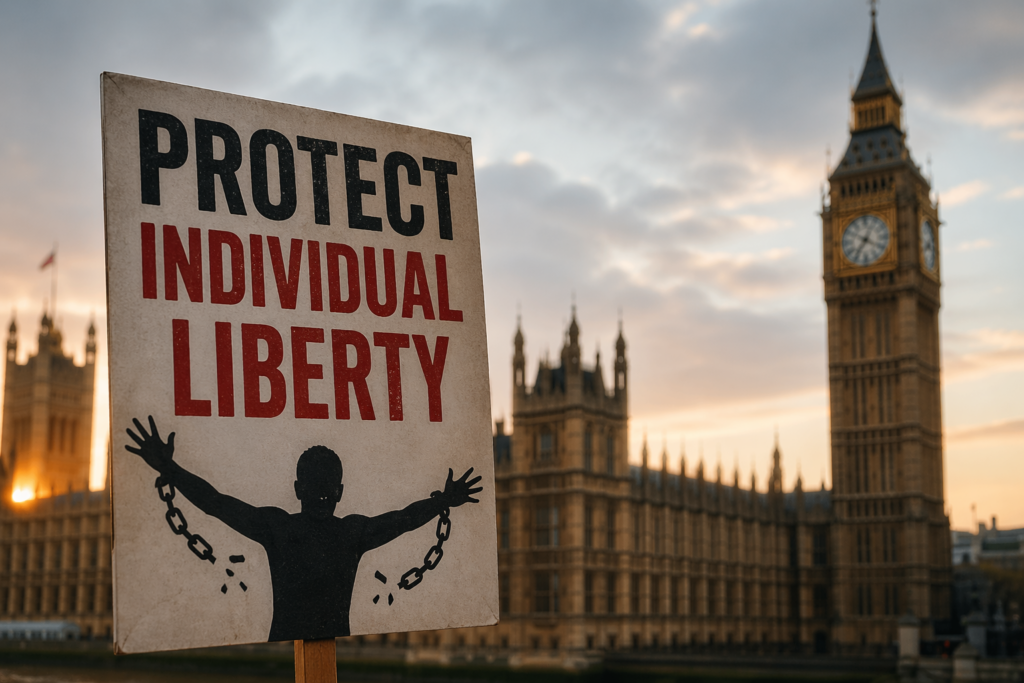
The Erosion of Liberty is a series of short blogs aimed to address the latest UK Government policies that infringe on individual freedom, personal agency and choice in markets. In this part, Mike Salem, UK Country Associate, tackles the recently passed Tobacco and Vapes Bill
The concept of individual liberty is increasingly under threat across the West. Once a bastion of personal autonomy and limited government, a model many nations sought to emulate, Western societies now find themselves governed by an expanding web of technocratic directives prescribing how citizens ought to live according to abstract public-health metrics and bureaucratic priorities. The passage of the Tobacco and Vapes Bill is emblematic of this shift: a move away from informed personal choice and toward a paternalistic model in which the state assumes greater authority over individual behaviour.
For decades, liberal democracies distinguished themselves by recognising a simple principle: adults are capable of making decisions for themselves, even when those decisions involve risk. Governments existed to uphold the rule of law, preserve public order, and protect citizens from coercion, not to curate every aspect of private life. Yet increasingly, policymakers justify intervention not on the basis of direct harm to others, but on the premise that individuals cannot be trusted to weigh risks and rewards for themselves.
The Tobacco and Vapes Bill sat firmly within this trend. Framed as a public-health intervention aimed at reducing smoking prevalence and preventing youth nicotine uptake, the legislation extends beyond regulating products or restricting youth access. Instead, it introduces a precedent-setting approach: permanently prohibiting future generations from legally purchasing tobacco products based solely on their year of birth.
Through our work, alongside other freedom-minded organisations, many of the concerns surrounding this legislation were made clear from the outset. Critics warned that the bill discriminated on the basis of age, creating unequal legal rights between adults. Others highlighted the likelihood of fuelling black-market activity, exposing consumers to unregulated products, and strengthening criminal networks rather than reducing demand. There are still also unresolved legal and constitutional questions, particularly regarding how the legislation aligns with the Windsor Framework and Northern Ireland’s position within overlapping UK and EU market rules.
Yet despite these concerns, the government pressed ahead. Supporters argue that smoking remains a significant public-health burden and that bold action is necessary to prevent future illness and reduce healthcare costs. The Secretary of State for Health defended the policy by stating:
“Prevention is better than cure – this reform will save lives, ease pressure on the NHS, and build a healthier Britain.” He also argued that “there is no freedom in addiction.”
But the central question is not whether smoking is healthy. It is whether the state should possess the authority to decide which legal choices adults may make for themselves.
To suggest there is “no freedom in addiction” is to misunderstand the role of personal agency. Addiction is not overcome through the removal of liberty, but through the capacity to exercise it. The freedom to quit, to change behaviour voluntarily, remains the only meaningful and sustainable route to personal responsibility. The government’s language reveals a deeper assumption: that citizens are not trusted to make decisions in their own interest and should not do so, and that state intervention must therefore fill the gap.
The generational ban at the heart of the legislation creates a troubling precedent. Under such a system, two adults standing side by side could be treated differently under the law based solely on when they were born. One may legally purchase tobacco; the other may not, despite both being legally recognised adults. This is not merely regulation; it is a departure from equal treatment under the law.
The issue is not whether tobacco products carry risk. But almost every product, habit, or lifestyle choice carries some degree of risk. The real question is whether public-health metrics become sufficient justification for governments to override informed adult choice.
This shift toward paternalism reflects a broader political philosophy increasingly visible across Western policymaking. Citizens are no longer viewed primarily as autonomous individuals capable of making trade-offs; instead, they are treated as subjects to be nudged, managed, or restricted in pursuit of socially desirable outcomes.
Such an approach may emerge from good intentions, but good intentions alone do not justify expanded state power. History shows that liberty is rarely lost in a single dramatic moment. More often, it erodes incrementally, through policies presented as reasonable, compassionate, or necessary. Each new restriction may appear narrow and justified in isolation, but together they reshape the relationship between citizens and the state.
There is also a practical concern often ignored in debates surrounding prohibitionist policy: unintended consequences. Restricting access to legal products does not eliminate demand. Instead, it can push consumers toward informal or illicit markets where quality controls disappear and criminal networks fuelled with profits. Public policy should be judged not only by its intentions, but by its likely outcomes. What was intended to be a preventative healthcare measure will end up increasing criminal activities.
A liberal society should not be defined by the absence of risk, but by the presence of choice. Adults should have access to accurate information, transparent labelling, and clear regulations that prevent fraud or youth access. Beyond that, individuals must retain the freedom to make decisions, even imperfect ones, about their own lives.
The Tobacco and Vapes Bill was in essence not just a debate about nicotine products. It was a debate about the boundaries of state power and the future of personal autonomy. Once governments claim the authority to permanently prohibit legal behaviour for competent adults in pursuit of a collective health objective, the principle at stake extends far beyond smoking.
The question policymakers should ask is not whether they can legislate away unhealthy behaviour. It is whether doing so undermines the very liberal principles that democratic societies claim to protect. Liberty is not preserved by assuming citizens are incapable of self-governance. It is preserved by trusting them to make choices, and accepting that freedom, by its nature, includes the freedom to choose poorly.