

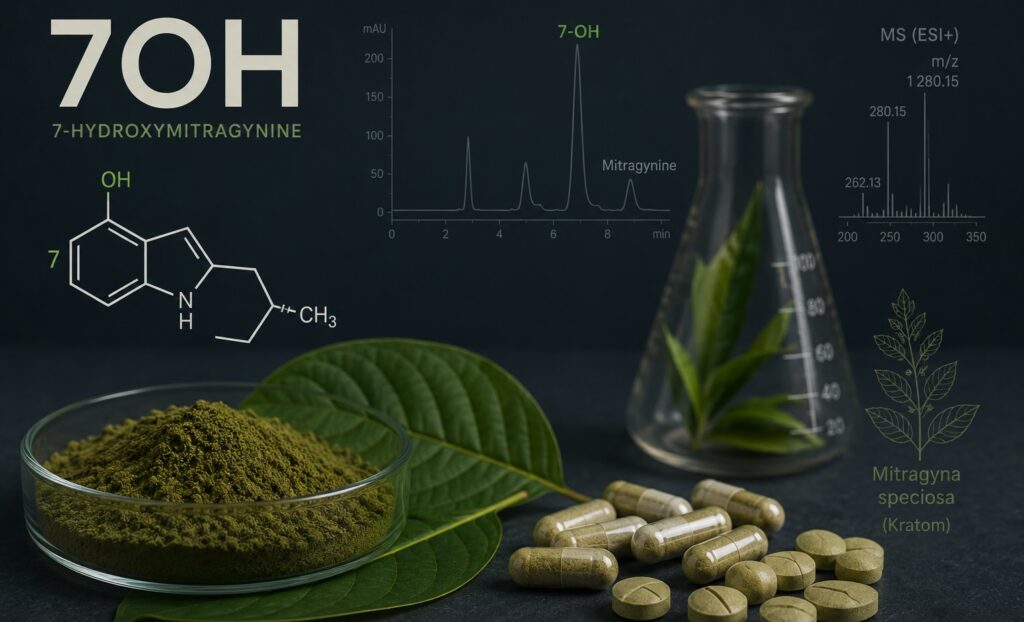
What H.R. 8000 does — and why the “synthetic” carve-out is the problem
H.R. 8000 (Bilirakis, R-FL) amends Schedule I of the CSA to add 7-hydroxymitragynine, “including its synthetic equivalents,” while purporting to exempt 7-OH “naturally contained” in Mitragyna speciosa (kratom). The carve-out is the entire problem.
The term “synthetic equivalents” is undefined in the bill. In practice, it can be read to capture every concentrated, extracted, or refined 7-OH product on the market — the same products President Trump publicly endorsed approving on May 10, 2026. H.R. 8000 is regulatory capture dressed as drug control, and the policy outcome the legacy kratom-leaf industry has been chasing for two years.
H.R. 8000 reverses President Trump’s stated policy
On May 10, 2026, from the Oval Office, the President said his administration is “looking very seriously at natural 7-OH and getting that approved … a lot of people are asking for it.”
A Schedule I listing for the only commercially relevant form of 7-OH cannot be reconciled with that statement. It would force the administration into an immediate public reversal and undercut a harm-reduction posture the President has consistently taken on other issues areas: on nicotine alternatives, on cannabis rescheduling, and now on kratom alkaloids.
Science does not support Schedule I
Schedule I is statutorily reserved for substances with high abuse potential and no accepted medical use. The peer-reviewed pharmacology and the federal government’s own adverse-event data do not put 7-OH in that category:
- Americans have consumed roughly 2 billion servings of 7-OH since 2023. FDA’s adverse-event database (FAERS) logs about 100 reports — one event per 20 million servings, fewer than the agency receives about ordinary soap.
- A 2021 paper in the Journal of Pharmacology and Experimental Therapeutics showed 7-OH binding at the mu-opioid receptor closely mirrors buprenorphine, the medicine physicians use to treat opioid addiction and reverse opioid poisoning.
- Department of Defense–funded research at Memorial Sloan-Kettering, conducted under a grant for non-addicting analgesics, found 7-OH does not produce respiratory depression — the mechanism that actually kills opioid users.
- A 2025 study in the European Journal of Drug Metabolism and Pharmacokinetics found only 2.7–3% of an oral 7-OH dose survives first-pass metabolism. Most is broken down before it reaches the brain.
- Medical Toxicologist Dr. Edward Boyer testified in March 2026 in Ohio that “a signal arising from overdose death from 7-hydroxymitragynine is absent.” America’s Poison Centers have reported no confirmed overdose deaths from 7-OH consumed in isolation.
The “13 times more potent than morphine” and “gas station heroin” slogans driving cable-news coverage are press-release lines, not findings. The Los Angeles County Medical Examiner reports cited by federal officials never measured 7-OH concentration at autopsy, skipped internal examinations in roughly a third of decedents, and have never been published in peer-reviewed literature. One headline death was reclassified once a blood-alcohol level several times the legal limit was identified.
The “synthetic” carve-out is a Trojan horse for regulatory capture
The legacy kratom-leaf industry survived the DEA’s 2016 emergency scheduling attempt and is now seeking to use federal scheduling against its competitors by labeling concentrated, plant-derived 7-OH as “synthetic.” Without a tight statutory definition, DEA enforcement will sweep in the entire commercial 7-OH market while leaving leaf and powder products untouched.
The exemption is not protection of natural 7-OH; it is market allocation, and it is the same boomerang the leaf industry now wants to throw at its own competitors.
Prohibition pushes >1 million Americans toward Chinese synthetics and cartels
Roughly 1 million Americans currently use 7-OH for pain management, opioid-use-disorder management, or to avoid prescription opioids and street fentanyl. A Schedule I listing does not eliminate that demand; it routes it offshore.
Synthetic kratom analogs MGM-15 and MGM-16 — manufactured primarily in China — have already entered states where 7-OH was restricted, using the same gray-market import networks that flooded American communities with fentanyl. H.R. 8000 accelerates that pipeline. That outcome is directly contrary to the President’s agenda of dismantling fentanyl supply chains.
The smart-regulation alternative already exists
An adult-use federal framework — product registration, third-party lab testing, potency caps, child-resistant packaging, mandatory adverse-event reporting, and aggressive enforcement against truly synthetic analogs like MGM-15 — accomplishes what H.R. 8000 claims to do, without prohibiting the product Americans are actually using. Several states have already adopted versions of this model.
CCC and a coalition including the Taxpayers Protection Alliance, Students for Sensible Drug Policy, Moms for America Action, Doctors for Drug Policy Reform, and End It For Good formally endorsed this approach in our May 21, 2026, letter to the President and CMS Administrator Mehmet Oz.
The Consumer Recommendation:
REJECT H.R. 8000 and the Committee aligns Congress with the science, with the President, and with the harm-reduction posture his administration has been building. CCC respectfully urges the Committee and the broader Congress to reject H.R. 8000.
SOURCES
- H.R. 8000, “End Needless Distribution of 7-OH Act” (Bilirakis), Congress.gov
- The 7-OH Panic Doesn’t Survive Contact with the Data (CCC, May 6, 2026)
- Why Trump Is Right to Protect “Natural 7-OH” (CCC, May 12, 2026)
- Consumer Choice Center Leads Coalition Supporting President Trump on Natural 7-OH (CCC, May 21, 2026)
- Obeng et al., “Pharmacological Comparison of Mitragynine and 7-Hydroxymitragynine,” J. Pharmacol. Exp. Ther. (2021)
- Chiang et al., “In Vitro and In Vivo Pharmacokinetic Characterization of 7-Hydroxymitragynine,” Eur. J. Drug Metab. Pharmacokinet. (2025)
- Dr. Edward Boyer, testimony to the Ohio House Agriculture Committee (Ohio House Agriculture Committee, March 2026)