Removing hurdles for air-conditioning availability in Europe
KEY POINTS
Europe kills tens of thousands annually in heat waves while simultaneously making it harder for consumers to protect themselves
AC penetration stands only at 19% (vs. 90% US, 91% Japan). This is not a cultural inevitability but a regulatory outcome
Patchwork of facade rules, heritage permits, condominium consent requirements, inspection mandates, and noise ordinances across EU member states creates a de facto barrier to a life-saving product
CCC's ask: harmonize, streamline, and in many cases simply remove these restrictions
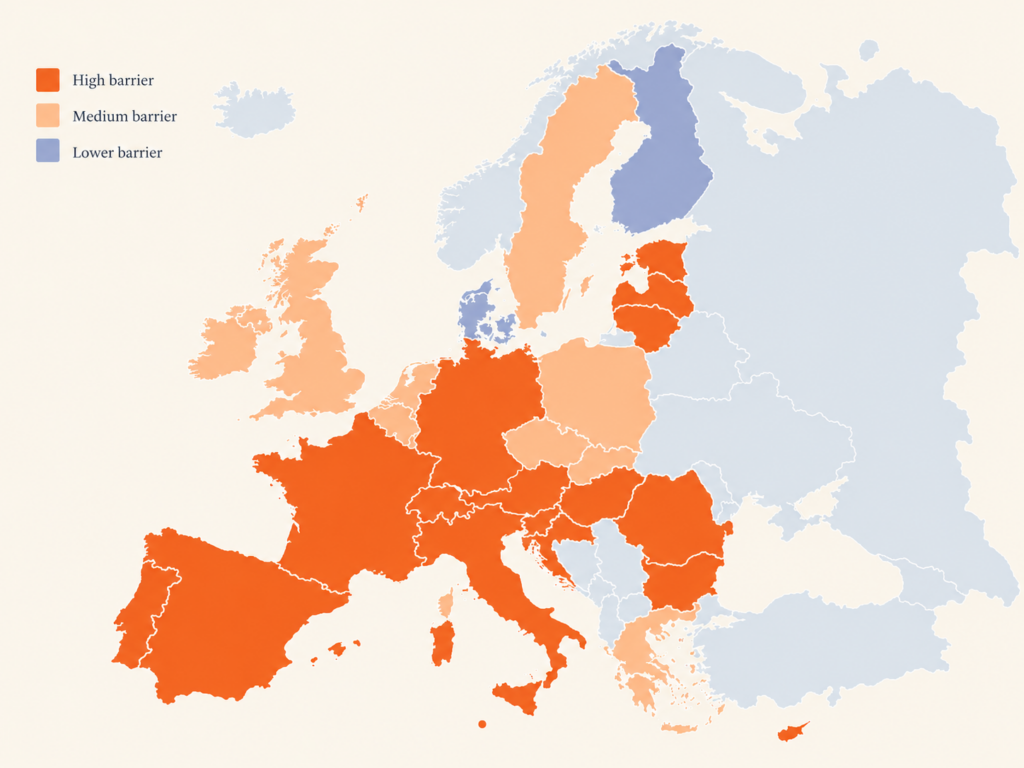
A Patchwork of Barriers Across Europe
Every summer, Europe bakes — and every summer, thousands die. In 2024, more than 62,700 people across the continent lost their lives to heat-related causes, a 23 percent increase on the year before.
Yet while nine out of ten homes in the United States and Japan have air conditioning, the figure in Europe is barely one in five. That gap is not cultural inevitability. It is a regulatory outcome.
Across the EU, the United Kingdom, and Switzerland, consumers face a patchwork of facade rules, heritage permits, condominium consent thresholds, energy inspections, and noise ordinances simply to install a basic residential air-conditioning unit.
Country Examples
Examples from across Europe show how barrier levels vary by country.
Low regulatory friction; standard building rules apply, with no identified AC-specific national permit regime.
Human Cost of Cooling barriers
Europe’s cooling restrictions do not fall equally. They hit elderly residents, disabled people, low-income renters, and apartment dwellers hardest — the people least able to leave during a heat wave, gather neighbour signatures, file municipal applications, or appeal permit denials.
The problem is not that cooling technology is unavailable. It is that a product that can protect people during extreme heat is often kept behind a bureaucratic wall. In many countries, residents who want to install a basic split air-conditioning unit face facade rules, heritage permits, condominium consent thresholds, energy inspections, and noise ordinances.
This is a regulatory failure. Rules designed for major building renovations are being applied to ordinary residential cooling units, often without proportionality or public-health consideration. A small outdoor AC unit can be treated as a building alteration requiring municipal sign-off or neighbour approval, even when the health stakes are immediate.
The result is delay, uncertainty, and unfairness. Apartment dwellers face the greatest burden, while consumers who cannot navigate the legal process may turn to informal or unpermitted installations. That creates exactly the safety risks regulators should want to avoid: poor drainage, unchecked wiring, and installations carried out outside a clear legal pathway.
Europe cannot call extreme heat a public-health threat while making the most direct household protection against it legally difficult to access.
POLICY RECOMMENDATIONS
What Should Change
Cooling access should be treated as climate adaptation.
The goal is not to remove basic safety standards, but to make legal installation simple, fast, and predictable.
Create a clear right for residents to install individual cooling equipment.
Exempt small residential AC units from excessive facade and heritage rules.
Replace neighbour vetoes and high consent thresholds with simple notification procedures.
Set a 21-day deadline for permit decisions, with automatic approval if authorities do not respond.