



“The knowledge of the circumstances of which we must make use never exists in concentrated or integrated form, but solely as the dispersed bits of incomplete and frequently contradictory knowledge which all the separate individuals possess.”
–Nobel Prize-winning economist Friedrich A. Hayek, 1945, The Use of Knowledge in Society.
The human pursuit of knowledge and information has been universal. Scientists, researchers, students, and entrepreneurs on every continent have sought to uncover and reorganize information to make more impactful and revelatory decisions about the world we share.
Finding a “concentrated or integrated” form of knowledge, as Hayek mentions, was impossible in his time — but thanks to technological breakthroughs and reduced global barriers, today’s innovations are bringing us one step closer. We’re using knowledge as a discovery procedure at a fast clip.
The Internet — sustained by landlines, cell towers, data centers, submarine cables, and satellites — allowed for the free exchange of untold amounts of information, but it hasn’t had a good track record of incentivizing accurate and well-founded information. What is now emerging, through mechanisms of spontaneous order, are products for aggregating, quantifying, and ordering knowledge in ways that improve our ability to forecast future events. It’s a market used for knowledge.
Those innovations are prediction markets — and prediction markets are beautiful.
These platforms are an attempt at answering Hayek’s quest for a “concentrated or integrated form” of knowledge, developing unique pricing systems for the aggregation of private information into collective forecasts defined by a language we all understand: Money.
Playing the Odds
On the most popular prediction market websites today: Polymarket, Kalshi, PredictIt, and Manifold Markets — users wager on certain outcomes, whether that be in politics, sports, geopolitics, or the markets. There are rather serious issues (Iran strikes by…) with financial positions staked out, and one’s you might consider more silly (‘Scream 7’ Rotten Tomatoes score will be….).
To any casual observer of these events, there is a lot of information they just don’t have on their own. While some individuals may be participants in a specific industry or even have some special role in an event, they only possess certain knowledge. And practically nobody has perfect insight on potential outcomes.
A highly skilled sports statistician may know the average yards per quarter rushed by a Patriots running back — and an executive at Apple may know when they’re due to launch a new iPhone, but because the outcomes depend on uncontrollable factors ranging from the weather or a player injury to the launch of a competing product by a rival, all of that knowledge is only one part of the equation.
By taking dispersed knowledge and information and putting a price on it that anyone in the world can wager on, it serves the purpose of a real-time discovery mechanism with all the baked-in incentives that real assets and capital provide.
Not only is this beautiful, but it’s rather genius.
Prediction markets are one of the best recent examples of innovative markets doing what they do best: turning dispersed knowledge into legitimate forecasts, giving consumers both a little fun, and actionable value that outperforms legacy polling or punditry.
24/7 event forecasting platforms give anyone watching them a real edge. That’s worth celebrating.
Useful Knowledge In Society
Which team will be crowned 2026 NBA champions? Who will win the 2028 Democratic presidential nomination? Will the US confirm alien life by 2027?
Now, information gleaned from prediction markets sets the mood, informs journalistic enterprises, and sways political decisions. People close to the topic and subject can make trades against others who may only be observers, which then further informs the market and updates prediction scenarios.
This is a similar metric to the stock market when it comes to the health of a company but has broader implications. Who needs dinosaur-age public polling in politics when people are putting money where their mouth is to predict the next mayor of New York or GOP nominee for Senate in Maine?
These markets deal in fluid information and price it accordingly, ready to be swung or changed when new information emerges. And this is the kind of truth-seeking mechanism that provides dividends in fields beyond just politics and sports.
A study published by the Federal Reserve in February 2026 examined market-related forecasts on the platform Kalshi. The researchers found that these markets “provide a high-frequency, continuously updated, distributionally rich benchmark that is valuable to both researchers and policymakers.”
They also make the point that prediction markets are “well-behaved, responsive to news, and comparable in forecasting accuracy to established benchmarks,” and “provide unique insights—particularly for variables like GDP growth, core inflation, unemployment, and payrolls, for which no other market-based distributions currently exist.”
If the “wisdom of crowds” can better analyze and price information than the top rating agencies and firms on Wall Street, shouldn’t this be a technology that we champion?
Looking at the top ten markets by volume on the two biggest platforms, we can see the markets are diverse.
The $406 million spread across Kalshi’s top markets are diverse. Five markets are on US domestic politics, 3 rely on sports, and the last two are geopolitics and the price of Bitcoin.
The ten most capitalized markets on Polymarket, totaling a whopping $3.34 billion, run along the same lines. Five deal with US domestic politics, four on sports, and the remaining one on geopolitics.
Nobel Pursuit
While most news headlines focus today on the burgeoning commercial industry of prediction markets, they have a much more humble beginning arc.
The first modern prediction market architects, who followed the traditions of Roman street traders and British agricultural gurus, were not crypto-native millennials or Wall Street titans, but rather tweed-jacket-wearing professors at the University of Iowa.
In 1988, they launched the Iowa Political Stock Market, then renamed Iowa Electronic Markets, allowing students to place bets on certain political predictions, thereby allowing them to put skin in the game and adjust their wagers based on changing information. The academic research that followed revealed that many of these markets were more accurate and predictive than public polling, introducing the incentive mechanism to better forecast future events.
Though it was designed as an experiment, the IEM quickly became a popular forecasting tool used by hundreds of universities worldwide.
In a similar academic-to-market creator progression, the father of algorithmic prediction markets, Robin Hanson, who developed the Logarithmic Market Scoring Rule (LMSR), recognized that allowing an algorithm to become a market maker would unleash the innovations that undergird all the prediction markets we have today.
For Hanson, these prediction markets are especially useful because they create incentives for revealing the truth about a future outcome or event. They also force participants to wager on their actual beliefs rather than preferences, and encourage true information discovery by aggregating dispersed knowledge. This is much different from traditional gambling or investing markets.
Keeping to academia, the true innovative nature of prediction markets can best be revealed by applying the economic principles of three Nobel Prize laureates.
For Hayek, prediction markets are the pure application of the theory of a refined price system, calculating not only current data, but also beliefs of the future.
For Buchanan, the purveyor of public choice economics, he would view these markets as a perfect mechanism to reduce informational asymmetry, discipline lawmakers by making the impacts of their policies more transparent, and providing the incentives to deliver better governance.
For Coase, prediction markets would serve as the perfect vehicle for reducing transaction costs, specifically those in information and institutions. Because the costs to find information and coordinate would be reduced, it would allow increased efficiencies in firms and markets. Any incompetence would be easily revealed.
Insiders Beware
One criticism of prediction markets is their susceptibility to being gamed by insiders who may either drive certain events or be able to affect outcomes.
A recent example is the announcement of an investigation by crypto sleuth @ZachXBT, who claimed that a large crypto business had employees who abused internal data to profit on their own. Almost immediately, a prediction market was launched to identify the company of concern. The volume of the market ballooned to nearly $40 million as traders swapped theories and watched trades intensely.
As can be seen below, and was later revealed by following the blockchain, the very people being accused of insider trading in their day jobs were also insider trading the market, to the tune of $1 million.
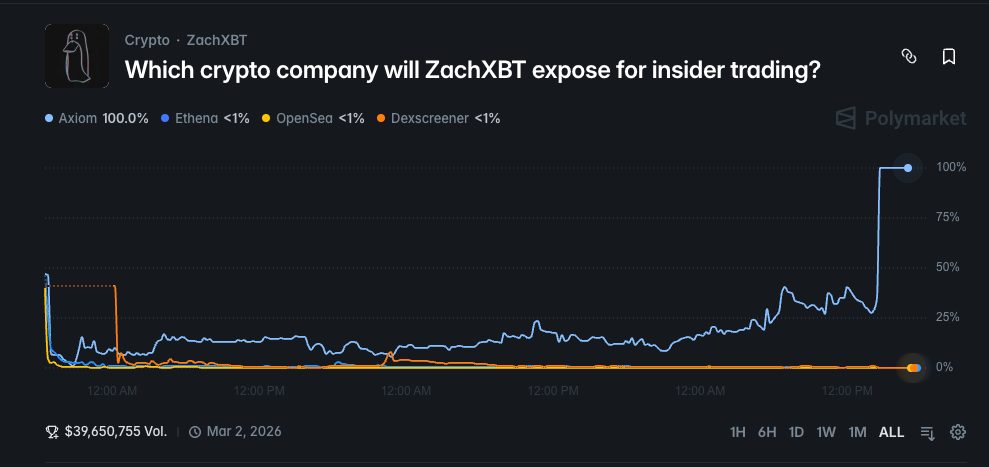
What do we learn from this? The public nature of these markets are difficult to game without detection. Crypto detectives used blockchain analytics to follow major trades that swung the market and helped identify the wallets and people making the trade, pointing to the very people at the heart of the alleged insider trading.
For one, as the chart denotes, the first guesses and bets were random. As time went on, however, and the insiders placed their own bets, a clearer version of the truth emerged. A full two days before the report was republished, the market was leaning toward Axiom, the alleged company where the insider trading took place.
For Polymarket, which integrates use of pseudonymous cryptocurrency wallets, this is rather transparent. On other markets, most of this information is seen internally.
This makes the traditional concept of “insider trading” a difficult one to apply to prediction markets because all wagers are 1) Publicly available and 2) Fed into the same market as any other guesses. If the market reveals the true price of a particular outcome much sooner because of “insider knowledge,” this changes the fundamentals and direction of a market.
Unlike in equities markets, where insider trades are hidden and create systematic disadvantages, insider trades in public prediction markets are immediately visible to all participants and incorporated into the price signal.
Of course, some participants may be self-interested, especially if we’re talking about a politician who will reveal a policy or manipulate the outcome of an event, such as the runtime of a speech, not to mention the cryptocurrency crowd.
But because prediction markets are publicly auditable, it’s not hard to trace where trades originate. And if we want to put better safeguards to avoid this, especially for government officials, we have avenues we can follow, as the CFTC has pledged and markets like Kalshi have self-policed.
Ultimately, the rules that govern these markets will evolve from how we learn from other industries, while being tested with new circumstances and fringe cases. How we choose to proceed with that regulation, prudent or not, will matter.
“I’m Shocked, Shocked To Find Gambling Going On In Here”
Now, one of the most important questions facing this innovative trend is how our societies should govern it. Should prediction markets continue unabated, or should reasonable rules apply? And how should this differ from gambling websites, casinos, or investing in the markets? What about regulation by the states or by the Commodities and Future Trading Commission (CFTC)?
For people like former New Jersey Governor Chris Christie, now an advisor to a sports gambling association, prediction markets should be at the beck and call of state lawmakers and register as “gaming” companies. That would be 50 different licenses, liquidity pools, and groups of users for a single prediction market.
CFTC Chair Michael Selig, on the other hand, believes in the innovative nature of these markets and wants to provide a light regulatory framework that will better benefit observers and participants across all 50 states.
The more important point is that traditional gambling is zero-sum. The house takes a cut and participants win or lose against each other with no information externality. Prediction markets, by contrast, generate a public good: the price signal itself. The bettor profits, but so does anyone who consults the market for a forecast. That externality is precisely what the Federal Reserve study recognized.
No one argues that the options market are “gambling” despite being speculative — the distinction is whether the instrument produces socially useful price information, and prediction markets clearly do.
Critics have called options, futures, and cryptocurrencies speculative or gambling-adjacent, yet the law distinguishes them by their function. The same logic applies here.
Considering access to knowledge and information on forecasting events, these markets provide a much larger public benefit than trading gaming institutions. They are ultimately different, and our laws should reflect that.
Conclusion
The growth and availability of prediction markets are a welcome innovation in the 21st century. With fragmented cultures, markets, and streams of information, these public markets provide a benefit that goes far beyond the betting odds and winnings of willing participants.
These markets allow us to aggregate knowledge like never before, and offer the appropriate incentives so that we can have more accurate forecasting about future events and outcomes.
While there will be fringe cases that will make headlines or outrage some, the more tools and technologies we have at our disposal to better predict the future are helpful and potentially incredibly beneficial. Rather than shirk the opportunity to help this industry mature by shackling it with undue regulatory burdens, we should embrace the potential they represent.
Prediction markets are not just passing curiosities or academic experiments, but beautiful in every sense of the word. And the sooner our own laws and rules reflect that, the better.
CONSUMER CHOICE CENTER
Principles on Prediction Markets
- Prediction Markets enable access to publicly available, real-time information to better aggregate and predict true outcomes.
- Market outcome definitions should be clear, well-defined, unambiguous, and follow industry standards.
- CFTC oversight is the most coherent and consistent regulatory framework to govern this information market.
- Rules should focus on consumer safety, including reasonable standards on age restrictions, non-public information, and self-dealing that goes beyond the pale of ethical conduct.
- Evolving industry standards will create the best-informed approaches for dealing with questionable behavior.