

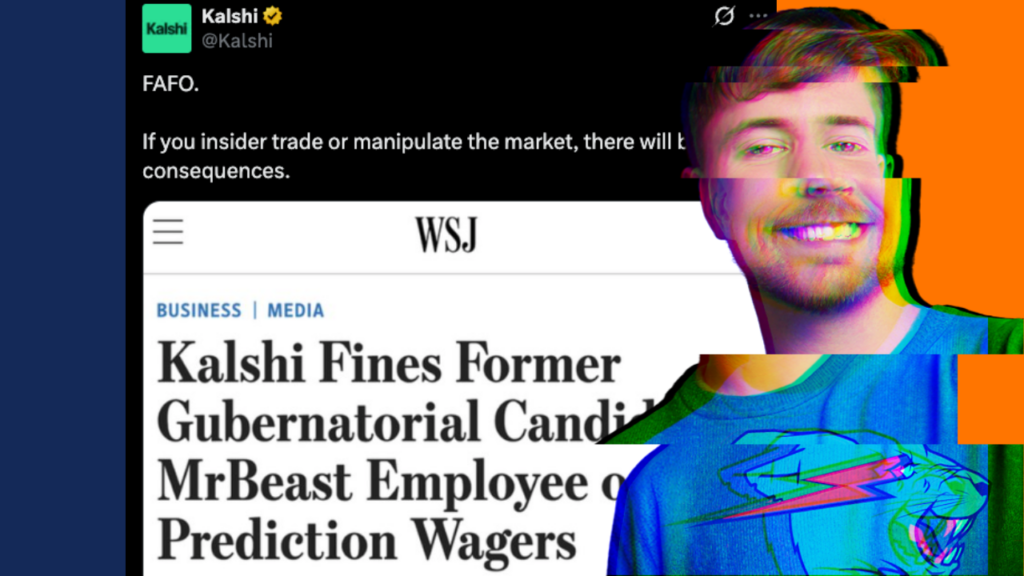
A MrBeast insider gets busted
Here’s what happened: The popular prediction market platform, Kalshi, caught a MrBeast employee trading on inside information about MrBeast-related contracts. The platform froze this person’s account, clawed back the winnings, reported to the authorities, and suspended the offender. In the same enforcement action, they also nailed a political candidate who was betting on his own election.
Like with instances of outrage over rigged games and FBI stings on corruption in sports, there is a knee-jerk reaction by critics to say, “Prediction markets are rigged!” “This is just unregulated gambling!” “Time to shut the whole thing down!”
Free markets are not free-for-alls.
But here’s what the panic-prone haters are missing: this story isn’t evidence that prediction markets are broken — it’s evidence they’re working. Kalshi detected suspicious trading, investigated it, froze funds, and punished the cheater with a $20,000 fine and a 2-year suspension. Legal consequences could follow for the video editor from MrBeast’s popular channel.
The actions taken by these firms should serve as a reminder that they’re serious about self-regulating and guarding public trust in their models and terms of service.
“We investigated and found that the trader was employed as an editor for the streamer’s show and likely had access to material non-public information connected to his trading,” said Robert DeNault, Kalshi’s head of enforcement.
MrBeast and his crew also commented, “We have a longstanding policy in place against employees using proprietary company information in order to safeguard the highest standards and ethics throughout our organization.” Their employees are banned from participating in these markets.
Right now, you can bet on who will win BeastGames season 2 on Amazon Prime. And if you’re an editor on that show, you already know, since it was taped months ago. This presents an obvious internal policy problem for firms and even militaries around the world. Israel has accused two men of leveraging army secrets for cash on Polymarket.
Let’s get real about what “insider trading” means here.
When most people hear “insider trading,” they think Wolf of Wall Street-style stock manipulation. But in event markets, the problem is much simpler: someone with an unfair advantage made money off information or power they have to affect an outcome.
Imagine you’re a speechwriter for President Trump…you can score big by betting on the contents of a speech and writing it yourself. That concern has been pointed out by many — and Kalshi appears to be answering that by saying: We see you.
Users engaging in these sorts of shady practices are likely to be found out by the markets. Legally, there is no guaranteed penalty for someone like MrBeast’s rogue employee. Using confidential information to manipulate markets is prohibited by Kalshi’s rules and, in some cases, could violate federal law, enforced by the CFTC.
Military secrets and operational information, on the other hand, are more clear-cut.
None of this is remotely unique to prediction markets. Every market that handles real money has to solve the same basic problem: how do you stop cheaters and people gaming the system?
The CFTC has also offered its public comment on the situation
Some questions that actually matter:
- Can the platforms spot suspicious patterns?
- Can they block payouts when someone breaks the rules, and will they articulate more bright lines for (a) “nonpublic info,” and (b) “direct involvement”? Markets need predictable constraints, not vibes-based bans
- Will Know-Your-Customer rules be necessary to further restrict bad conduct?
The MrBeast case looks pretty good for the future of prediction markets. It shows what enforcement looks like when a platform treats integrity as survival — which it absolutely is.
And it should serve as a reminder to all that free markets are not free-for-alls.

Stephen Kent is media director for the Consumer Choice Center. Follow him on X @stephenkentx