


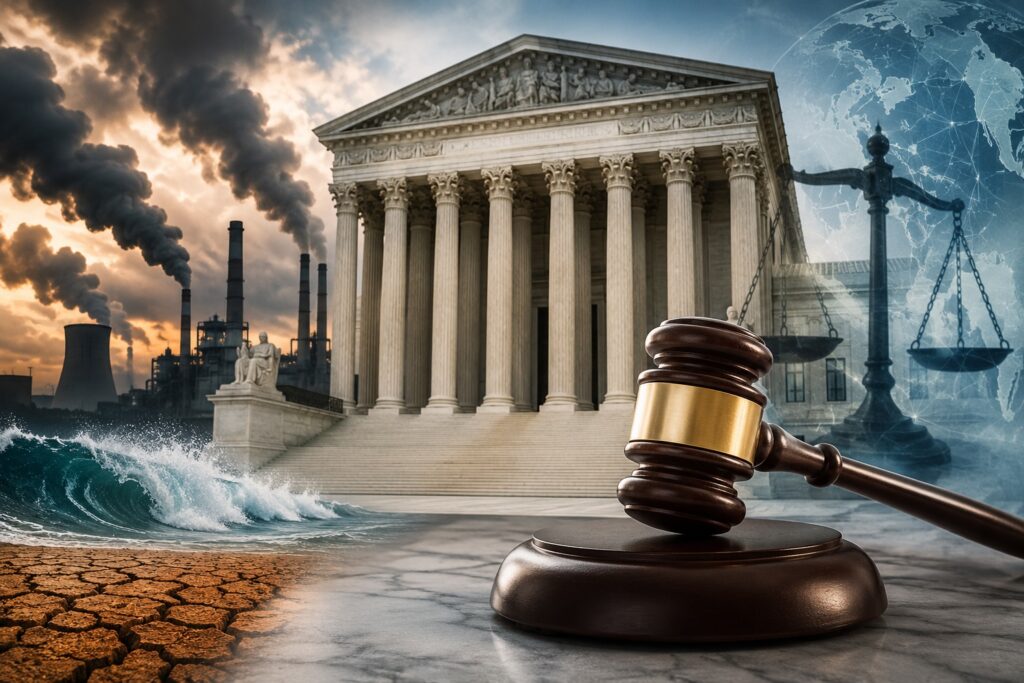
For eight years, the progressive city of Boulder, Colorado has flexed its legal muscles to try to dictate and control national energy policy and wage broad climate lawfare. The Supreme Court has vowed to take up the case, likely this fall, and it’s about time.
In 2018, the City and County of Boulder filed a lawsuit against Suncor and Exxon Mobil, demanding two energy producers pay tort-related damages for their role in contributing to climate change.
The modus operandi of these kinds of lawsuits has very little to do with climate change and even less to do with energy. Rather, as I covered in The Hill a few months ago, the point is to “bankrupt” oil and gas firms, as the former lead attorney in the Boulder case admitted:
These efforts have been coordinated by well-connected groups of state attorneys generals, university law programs and millions of dollars in funding from philanthropists who believe that climate litigation will help “bankrupt” oil and gas firms. David Bookbinder, a director at the Environmental Integrity Project who formerly was on the legal team in the suit launched against oil firms by the city of Boulder, Colo., recently admitted as much.
And there’s a reason these cases are launched in blue cities nestled in blue states: if a single biased jury in a single county can be persuaded to assign a “dollar value” to decades of lawful emissions, then every blue-state attorney general and trial-lawyer in the country would have a template to copy and paste in their own district. Dozens of lawsuits have since piled up behind it.
A Long Trail of Lawfare
This is the same project I’ve written about in a series of articles, blog posts and opeds because it’s an important point for consumers to understand. Much of this is based on “climate superfund” laws that have crept their way through statehouses in Vermont, New York and Minnesota that should outrage us all.
Superfund laws allow states to designate a climate “violator” (obviously energy companies), pick a certain point in time by which to judge and evaluate their climate emissions, and the have a legal path to fine said company however they see fit. This pivots American energy policy away from our accountable representatives in Congress to a nebulous web of state-level liability laws engineering and contorted to inflict maximum pain.
It’s an outrageous violation of not just the spirit of the Constitution and the rule of law, but likely the letter of it. That’s what the Supreme Court will tell us in the fall.
The Coming Supreme Court Smackdown
Nearly 40 amicus briefs were filed asking the Supreme Court to put a stop to it. The U.S. Department of Justice put it most plainly: “Can one city wield one State’s law to dictate how the rest of the world must address a global problem with global effects? The Constitution supplies the answer: Absolutely not.”
Sens. Ted Cruz, Chuck Grassley, Mike Lee and Ted Budd filed their own brief making the same point, as did 78 members of the House, 27 state attorneys general, the U.S. Chamber of Commerce, and a coalition of former senior foreign-policy officials including Mike Pompeo, James Baker and Nikki Haley.
Even Colorado’s own energy-producing counties that power the state, including Mesa, Garfield, Delta, Montrose, Montezuma and Rio Blanco, have filed their own lawsuit against city officials in Boulder, warning the lawsuit would gut the rural economies that fund their roads, schools and emergency services. The climate activists who wield power in Boulder don’t really seem to care.
With luck, the legal theory undergirding this climate lawfare will face certain death in court. Most judges can see through the ideological effort to reshape energy policy through local courts. I’ve tracked this pipeline before, from the Trump executive order taking aim at state climate lawfare, to the House Oversight probe into the Bloomberg-NYU network propping up these suits, to Carrboro, North Carolina’s strange attempt to sue Duke Energy over its nuclear fleet.
A South Carolina judge dismissed Charleston’s parallel case with prejudice last August. More than a dozen federal courts have rejected similar claims. The Colorado Supreme Court is the outlier, and SCOTUS now gets to fix that so that consumers across the country won’t be subject to an energy policy written by city officials who sound more like a faculty lounge than serious municipal officials.
Though the Supreme Court’s intervention will put some of this to rest, in the meantime there’s also a federal legislative fix via the Stop Climate Shakedowns Act. Consumers should support this. It not only overrides the state-level Superfund laws, but also puts legal barriers in the way of plaintiff lawyers and state AGs who want to craft national energy policy into some Green New Deal paradise that voters don’t support. We cannot continue the climate lawfare dressed up as tort claims.
Oral arguments at the Supreme Court are expected this fall. I hope I can make it. Consumers, who would ultimately pay every dime of any judgment at the pump and on the power bill, should be rooting for a smackdown.