



CONSUMERS SHOULD HAVE ACCESS TO SMOKING ALTERNATIVES
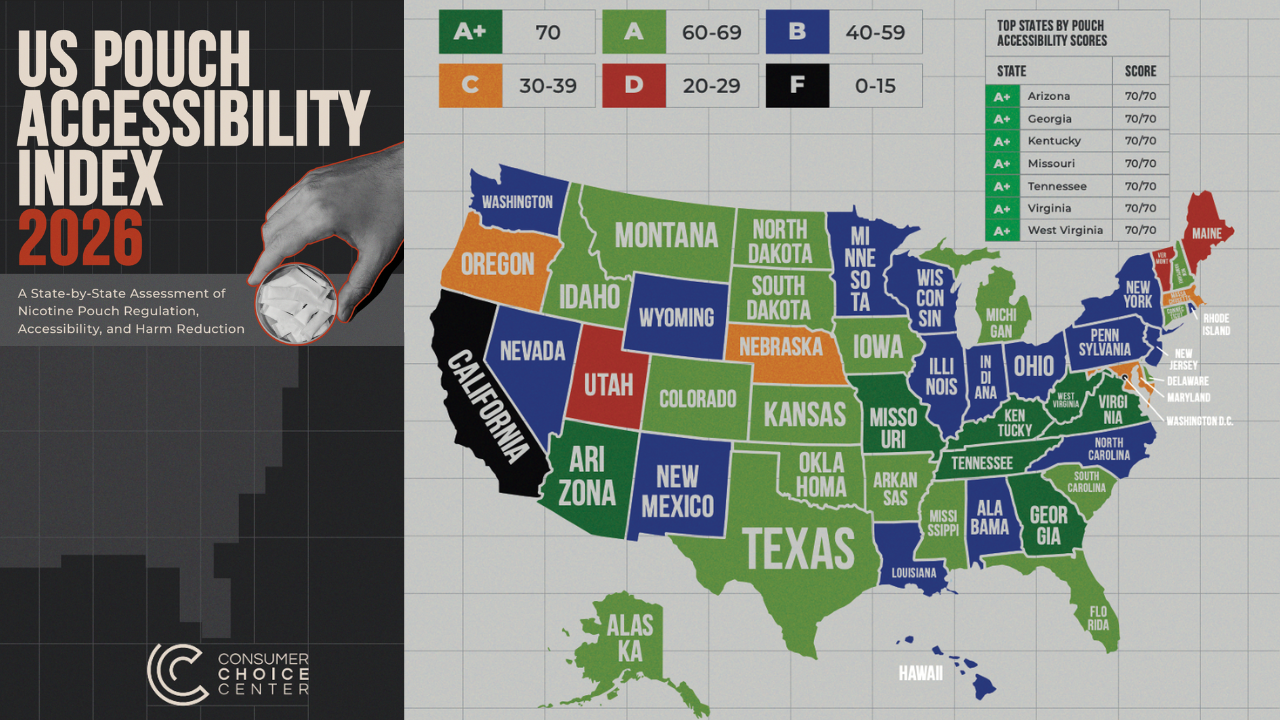
WASHINGTON, D.C. — The Consumer Choice Center has released its first Nicotine Pouch Accessibility Index, covering 50 states and the District of Columbia. It reveals that only seven states, Arizona, Georgia, Kentucky, Missouri, Tennessee, Virginia, and West Virginia, received an (A+) in the study for an evidence-based approach to nicotine pouch policies.
This rating means these states are well positioned to leverage harm-reduction tools in the campaign to reduce smoking while still allowing consumers to choose for themselves. Other states that perform well are Alaska, Delaware, Florida, Iowa, Mississippi, New Hampshire, Oklahoma, South Dakota, Texas, Arkansas, Colorado, Connecticut, Idaho, Kansas, Michigan, Montana, North Dakota, and South Carolina.
By contrast, 10 states have embraced restrictive policies on nicotine pouches and consumer choice, including California (0 points), D.C. (15 points), Vermont (25 points), Utah (25 points), Maine (25 points), Oregon (30 points), Nebraska (35 points), Massachusetts (35 points), and Maryland (35 points).
Elizabeth Hayes, Head of External Affairs for the Consumer Choice Center, commented on the implications of the Index, saying,
“Much like vapes, nicotine pouches have been unfairly vilified. Study after study shows that if smokers had the opportunity to switch to nicotine pouches back in 2000, there would be 700,000 fewer deaths from tobacco-related diseases by 2050. Unfortunately, policymakers in many states fail to recognize that pouches are a valid harm-reducing substitute for traditional combustible tobacco products. Constantly, pouches are misclassified as tobacco products in the press and by lawmakers, and accused of leading young people to cigarettes and other toxic substances. Due to these misconceptions, pouches face draconian flavor bans and punitive taxes higher than those on cigarettes…make that make sense. States are rushing to put pouches into registries meant to gatekeep consumer access and are banning them from online sales and convenience stores. These policies deter consumers from switching away from the more dangerous habit of smoking and fuel black markets. It’s that simple.”
The purpose of the US Nicotine Pouch Accessibility Index is to inform consumers about nicotine pouch policies in their area and to highlight the need for more informed, level-headed lawmaking.
The Consumer Choice Center weighed 7 factors in the Index:
1️⃣ Whether the state considers pouches to be tobacco products 2️⃣ State-level flavor restrictions, 3️⃣ Requirements for state registries (which mirror the FDA-authorized database), 4️⃣ Higher taxes on pouches, 5️⃣ The presence or absence of online sales bans, 6️⃣ The presence or absence of restrictions on points of sale, and 7️⃣ Nicotine caps (relating to the nicotine concentration allowed in products).
“We should be clear on the science. One of the most extensive work in existence found that oral nicotine pouches contain substantially fewer harmful substances than any cigarette. Direct studies also show that individuals absorb nicotine more slowly from pouches than cigarettes, contradicting the narrative of an equal addictive profile. Far from encouraging teenagers to pick up smoking, former smokers, not teens, represent virtually all current nicotine pouch consumers in America. The UK Royal College of Physicians is so confident in these findings that they’ve concluded: ‘in the interests of public health,’ it is important to promote the use of e-cigarettes, nicotine replacement therapies, and other non-tobacco nicotine products as widely as possible as a substitute for smoking,” Hayes concluded.
The entire Index can be found HERE