


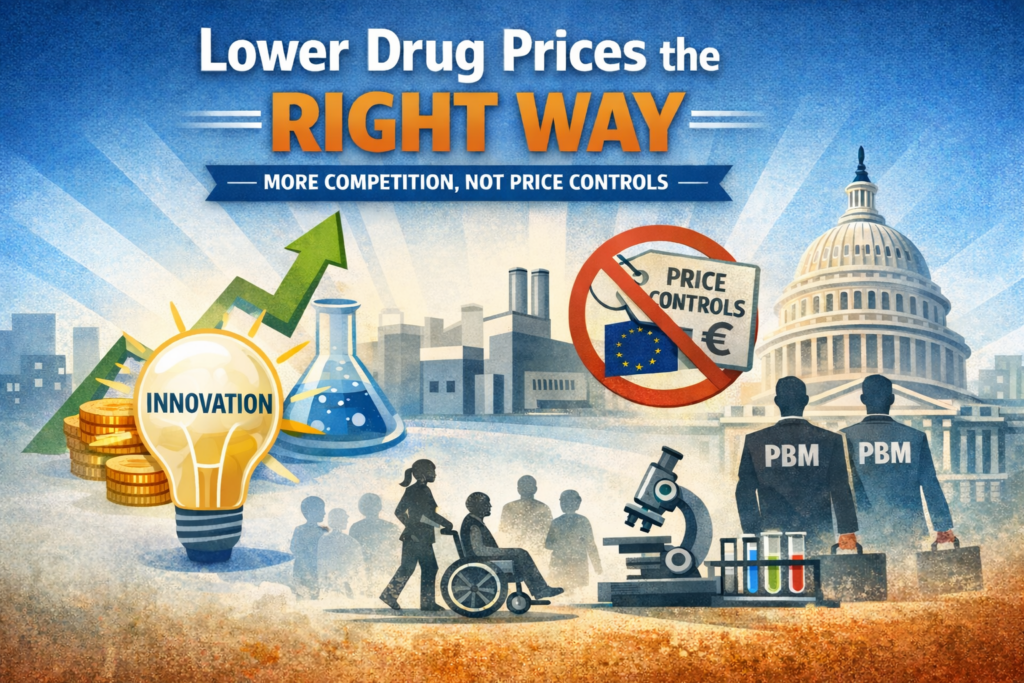
On Thursday, April 16, the Senate HELP Committee will hold a hearing titled Making Medicines More Affordable: How Competition Can Lower Drug Prices, featuring testimony from Brian J. Miller of Johns Hopkins and the Hoover Institution, Ryan Long of Paragon Health Institute and USC Schaeffer, and Robert Weissman of Public Citizen. That title gets the first principle exactly right: competition lowers prices. The danger is that Congress could use the hearing to justify policies that sound pro-patient but would actually reduce innovation, entrench middlemen, and make the system even less transparent.
If lawmakers want cheaper medicines, they should start with the reforms that actually work: speed up approvals and market access, crack down on anticompetitive conduct, and fix the incentives that reward insurers, pharmacy benefit managers, and hospital systems for higher spending.
Congress should stop pretending that every problem in the drug market begins and ends with manufacturers. The 340B drug discount program was created to support safety-net care, but it has grown dramatically and now deserves serious scrutiny. The Congressional Budget Office found that spending on drugs purchased through the 340B Prime Vendor Program rose from $6.6 billion in 2010 to $43.9 billion in 2021, with 87 percent of 2021 spending tied to hospital outpatient departments and off-site clinics. CBO also concluded that the program encourages behavior that tends to increase federal spending, including prescribing more and higher-priced drugs and integrating hospitals with off-site clinics. That is not a patient-centered affordability strategy; it is a warning sign that discounted drugs are too often becoming a revenue stream for institutions rather than direct relief for consumers.
The same goes for “most favored nation” drug pricing proposals. The Trump White House revived MFN pricing in a May 12, 2025 executive order, and the earlier CMS model would have tied payment for certain Medicare Part B drugs to the lowest price paid in comparable OECD countries. That is not a market reform. It is imported price setting dressed up as fairness. And when proposals extend that logic into already heavily regulated government programs, lawmakers should be honest about what they are doing: not unleashing competition, but replacing market signals with foreign benchmarks and administrative commands.
That matters because patient affordability and government reimbursement are not the same thing. For many Medicaid enrollees, prescription drug cost-sharing is already limited to nominal amounts, especially for those at or below 150 percent of the federal poverty level. In other words, simply increasing mandatory rebates inside Medicaid does not automatically translate into meaningful out-of-pocket relief at the pharmacy counter. It is more likely to deepen distortions elsewhere unless Congress also reforms the parts of the system that pocket discounts, manipulate formularies, or shift costs onto private payers and patients. That is an inference from the structure of the program, but it follows directly from Medicaid’s cost-sharing rules and the broader evidence on distorted incentives in federal drug purchasing.
Lawmakers should be equally cautious about using “patent reform” as a catch-all answer to high drug prices. Yes, abusive conduct that blocks generic or biosimilar competition should be targeted aggressively. But the answer is to go after abuse, not to weaken the intellectual-property rules that make biomedical investment possible in the first place. Even the FTC and DOJ’s own 2025 drug-pricing competition initiative focused on specific anticompetitive behavior: pay-for-delay arrangements, product hopping, improper Orange Book listings, sham litigation, formulary abuses, and other tactics that forestall lower-priced competition. That is the right frame. Punish gamesmanship. Preserve the incentives that finance the next generation of cures.
And if Congress truly wants to talk about middlemen, there is no shortage of evidence. The FTC’s PBM investigation found that the three largest pharmacy benefit managers imposed markups of hundreds or thousands of percent on numerous specialty generic drugs dispensed through affiliated pharmacies, generating more than $7.3 billion in dispensing revenue above estimated acquisition costs from 2017 to 2022. Patients do not benefit when Washington obsesses over foreign price indexes while vertically integrated intermediaries profit from opaque rebates, spread pricing, and steering. A pro-consumer drug agenda has to confront those incentives head-on.
Congress has a real opportunity this week. It can choose constructive reforms that increase transparency in 340B, rein in PBM abuses, and lower what patients actually pay. Or it can chase the easy headline: imported price controls, sweeping attacks on patents, and bigger distortions in programs that already fail to deliver savings cleanly to consumers.
Patients deserve cheaper medicines. They also deserve future cures. Washington should stop acting as though it must sacrifice one to get the other.