

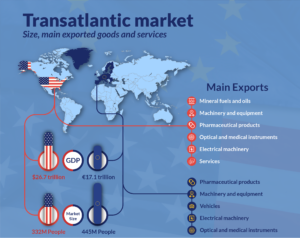
Following consequential election results in the United States and across Europe, the early part of 2025 has borne witness to a paradigm shift in policies, alliances, and future relations for people on both sides of the Atlantic.
The prospect of weakening transatlantic political, economic, and defense ties in favor of closer cooperation with illiberal, authoritarian regimes is deeply concerning—not only for policymakers and industry leaders but also for consumers and citizens in the EU and US.
Liberal democracies must contend with the will of their populations and be responsive to change, while illiberal countries like Russia and China have suborned democratic will in favor of centralized control and planning.
At this moment of upheaval, and as liberty-minded Europeans and Americans, we urge policymakers to adopt a long-term perspective and resist the temptation to undermine transatlantic cooperation for short-term tactical gains.
We call on industry representatives, political leaders, and policy experts to move beyond inflammatory rhetoric and instead foster constructive dialogue that strengthens our shared economic and security interests.
The US and the EU should strive to complement, not compete with each other, at the expense of our citizens, consumers, political and security ties, and the future.
The European Union and the United States have long been close partners, facilitating free trade and investment. In 2024 alone, their goods exchange totaled about $975.9 billion. The US remains a key security ally for EU Member States through bilateral agreements and NATO, while the EU has supported US missions in Afghanistan and Iraq. Innovation thrives on their cooperation in talent, technology, and research. As for the trade deficit, while the EU exports more goods to the US, American companies maintain a surplus of over $100 billion in service exports to the EU.
Transatlantic trade has brought significant benefits to consumers on both sides. Europeans have gained access to cutting-edge technological services from the US, while Americans have enjoyed high-quality European products. Beyond goods and services, this exchange has fostered innovation, strengthened economic ties, and enriched both cultures—proving that open trade is a win-win for all. Now is the time to fortify and strengthen these ties by rebalancing them for the modern age, rather than cutting them off in exchange for short-term transactional benefits.
The Russian economy, valued at over $2 trillion in GDP ($7.1 trillion in PPP, which thegovernment favors), is heavily reliant on exports of energy products, metals and minerals, and agricultural goods. Incontrast, China’s economy, amounting to over $18.2 trillion (or $37 trillion in PPP), is driven by exports of machinery, electronics, high-tech products, and energy resources.
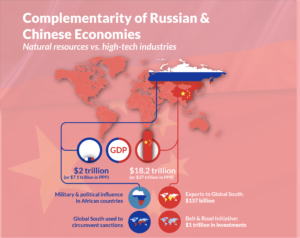
Russia and China continue expanding their influence in the Global South. In 2024, China’s exports to these countries hit $137 billion, while its Belt & Road Initiative has secured about $1 trillion in investments—mainly loans—since 2000. Russia, meanwhile, has used the Global South to bypass Western sanctions, increasing exports by $11 billion per month and displacing Western industries in Africa, particularly in metals and minerals.
As Russia and China align strategically, the US and EU risk drifting apart due to political and trade disputes. While both have attempted to rebalance trade dependence, shifting from competition to economic complementarity would better serve consumers and industries. Strengthening transatlantic cooperation is crucial to counter growing Russian and Chinese influence and ensure long-term economic resilience, innovation, and strategic stability for liberal democracies.
The EU and the US have vast potential for collaboration, particularly in energy, digital policies, minerals, agriculture, and defense. Better policy alignment can help businesses scale globally, benefiting local economies and consumers.
Energy: While the EU works to diversify and decarbonize, it still depends on Russian gas, with LNG imports worth nearly €7 billion annually. As the US shifts its energy policy, both sides can gain economic and political independence by deepening cooperation.
Minerals: Both rely on Chinese-sourced lithium, rare earth elements, and cobalt. Joint efforts in mineral research and development are essential, especially as Africa becomes a geopolitical battleground where China and Russia exert growing influence.
Digital: The US has a $100 billion trade surplus in digital services with the EU. However, regulatory misalignment—through the DSA, DMA, GDPR, and AI-related regulations—weakens both sides in setting global standards, while China advances its AI and tech agenda.
Green Deal: Concerns persist over the EU’s Corporate Sustainability Reporting Directive and its global implications. Clearer, balanced guidance is needed to align US and EU regulations while ensuring competitiveness.
Agriculture: Both blocs produce world-class agricultural goods but need to restore trade ties post-TTIP failure. A more stable import-export framework would support fair trade, especially during supply disruptions.
Defense: US-EU security cooperation remains mutually beneficial, ensuring long-term stability. NATO allies have consistently supported each other, from the Marshall Plan to post-9/11, and continued collaboration is crucial as China and Russia challenge global norms.
Energy
Buy American, not Russian gas
Streamline LNG terminals and energy import projects
Increase collaboration on energy innovation and technology transfer
Minerals
Accelerate alignment under the US-EU critical minerals agreement
Align on joint investment in mining and refining globally
Extend mineral trade opportunities with Canada
Digital
Make the most of cutting red tape for innovators – align goals
Ensure transatlantic independence from high-risk vendors
Cooperate and complement, not compete and bicker on AI – align on regulatory standards
Coordinate digital development projects in the Global South
Defense
Commit to further raises in defense spending
Incorporate mutual private actors into national defense
Continue the format of the EU-US cyber-dialogue
Agriculture
Ensure mutual recognition of regulatory standards
Analyze and evaluate subsidy schemes to avoid market distortions.
Restart negotiations on a comprehensive trade agreement
Extend red tape-cutting & simplification efforts to agriculture
Green Deal
Review the scope of Corporate Sustainability Reporting Directive – help European and American economies and consumers
—————————————————————————————————————————————————–
Intellectual property protection
Align on intellectual property – unite to protect European and American innovators globally
We will, from time to time, keep you updated on new and troublesome regulations in your country and ways that you can help use fight them. Don’t worry, being a member is always free!