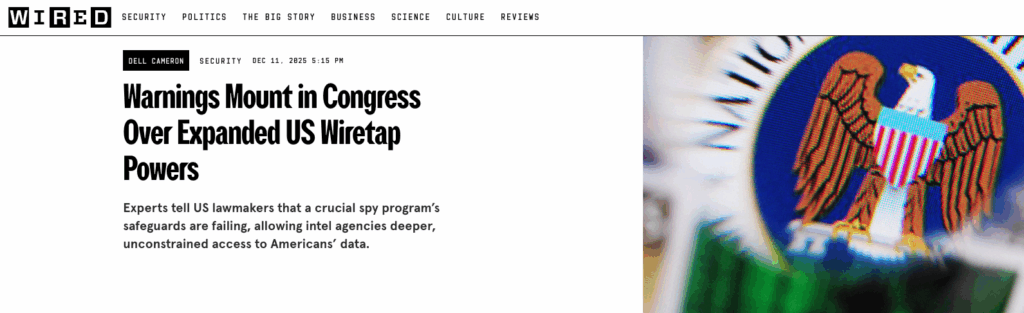
Yesterday, I had the honor of testifying before the full Judiciary Committee on the Foreign Intelligence Surveillance Act (FISA), specifically regarding the need for reform to Section 702, which is up for reauthorization in April 2026.
Congress originally passed the Foreign Intelligence Surveillance Act (FISA) in 1978 in response to findings of the Select Committee to Investigate Federal Intelligence Operations, led by Senator Frank Church, which uncovered rampant abuses by the FBI, CIA, NSA, and IRS, including surveillance of civil rights leaders, journalists, and political activists. The Committee revealed that agencies operated with little oversight, often violating constitutional rights in the name of national security.
To address these abuses, FISA established a statutory framework for electronic surveillance and created the Foreign Intelligence Surveillance Court to review government applications targeting foreign powers or agents inside the United States.
AN EVOLVING STATUS QUO OF SURVEILLANCE
Over time, Congress amended FISA to expand the government’s surveillance toolkit. For example, in the 1990s, new provisions authorized physical searches and electronic surveillance. Additionally, after the terrible attacks on September 11th, 2001, the USA PATRIOT Act further broadened FISA authorities, including “roving” wiretaps and access to “any tangible thing.” In the process, it significantly lowers the threshold required for government collection. These expansions reflect the government’s growing reliance on electronic surveillance but also raised concerns surrounding the erosion of privacy and the adequacy of judicial oversight.
Passed in 2008, Section 702 of the Foreign Surveillance Act expanded the government’s authority to conduct warrantless surveillance of suspected foreign terrorists. While this may appear to be a reasonable national security measure, its implementation has repeatedly blurred the line between foreign and domestic surveillance. In practice, Section 702 has become a go-to resource for the government to access Americans’ communications without the proper protections of a warrant.
Consider this: In 2022 alone, the Federal Bureau of Investigation (FBI) conducted 200,000 warrantless searches of the communications of American citizens using the Section 702 data.
PLUMMETING PUBLIC TRUST AND FOUR SOLUTIONS
In the hearing, I told the House Judiciary Committee that these rampant and repeated abuses have contributed to a decline in public trust in the key institutions that are charged with keeping Americans safe. In December of 2024, CNN’s Harry Entencited Gallup polling, which found that support for the FBI was at an all-time low, with just 41% of respondents feeling the agency was either doing an excellent or great job.
That figure represents an 18% decline over ten years.That is a freefall.
As I explained, “An intelligence apparatus that lacks the support of public trust is less effective, not more. Americans are less likely to cooperate with, have support for, or believe in institutions they fear.”
I told the committee that there are four key reforms that Congress should prioritize when looking to reauthorize this spying power:
Close the backdoor search loophole: This enables agencies to access the 702 database and search Americans’ phone calls, texts, and emails. This practice directly undermines the 4th Amendment protections afforded to Americans.
Close the data-broker loophole: Congress should also prevent the government from circumventing constitutional protections by purchasing Americans’ personal data from private actors without a warrant. Coupled with the backdoor search loophole, these end-runs around the Fourth Amendment chill free speech by making millions of Americans fear unwarranted government monitoring.
Strengthening third-party oversight at the FISA court: At a minimum, Congress should expand the role of neutral, third-party attorneys – or amici – within the FISA Court proceedings whenever Americans’ rights are at stake. FISA Court judges should be required to appoint amicus curiae to cases involving “sensitive investigative matters,” unless doing so would jeopardize an ongoing investigation or reveal sensitive methods. They should also be allowed to bring up potential issues with the FISA Court and have access to more information.
Fix the overly broad ECSP definition: During the last reauthorization of Section 702, an amendment was adopted that drastically expanded the definition of what was considered an Electronic Communications Service Provider (ECSP). Recently, the FISA Court had rejected an application that the intelligence community was seeking because the target in question did not fit the definition of what an ECSP was. We don’t know exactly what they were looking for, as that information remains classified, but based off reporting, we believe the intended target for the order was a data center. But rather than have a narrow definition change to include data centers, overly broad language was inserted, thus dramatically expanding the scope of entities that would now be conscripted into the intelligence gathering process.
Many of the reforms I advocated can be achieved by requiring intelligence agencies to obtain a warrant before searching Americans’ sensitive information. Additionally, these reforms will not end any ongoing surveillance or stop any legitimate national security operations. What they will accomplish is set up proper guardrails to reassert Americans’ constitutional protections.
This is a bipartisan issue in Congress, with both Chairman Jordan and Ranking Member Raskin agreeing on the urgent need for reform. The committee left the hearing excited and as determined as ever to work to ensure that changes are made to the program. There is a lot of work that lies ahead, but I assure you that my colleagues and I at the Consumer Choice Center will do everything in our power to ensure that the intelligence community serves the American people rather than surveilling them. The time to fix FISA is now.
James Czerniawski is the Head of Emerging Technology Policy at the Consumer Choice Center.