

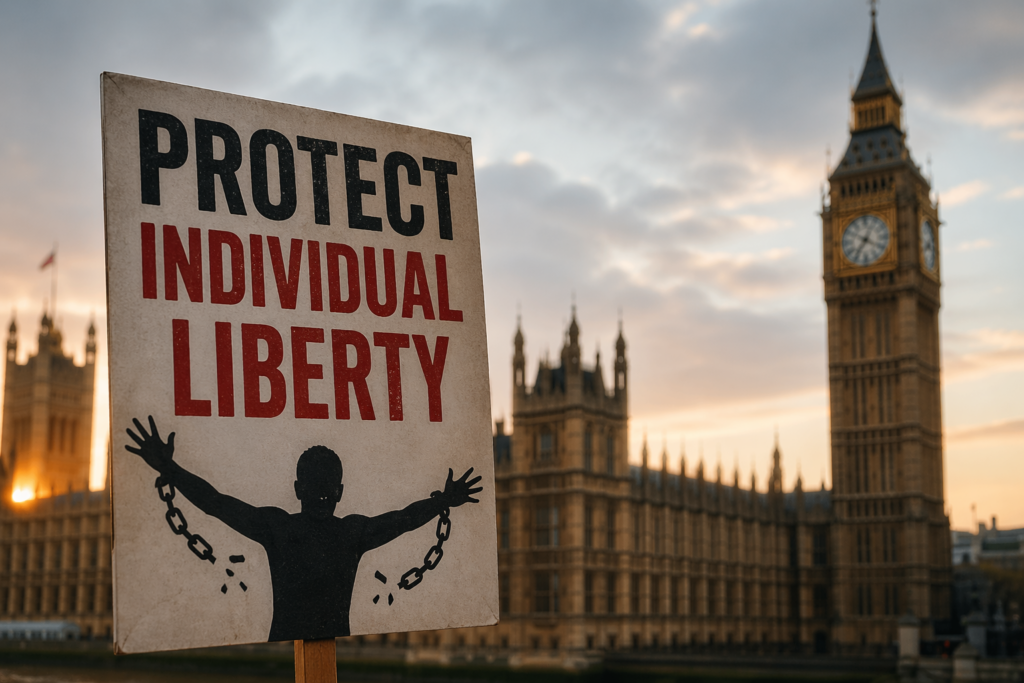
While King Charles III was away attempting to repair the UK-US “special relationship”, the government quietly performed a remarkable political U-turn on an issue that could become one of the defining civil liberties battles of the decade. Ministers who previously appeared cautious about imposing sweeping online restrictions on young people are now openly entertaining some form of social media ban for under-16s. The details remain vague, but the direction of travel is unmistakable.
What is perhaps most striking is not simply that the policy has resurfaced, but how enthusiastically it has been embraced by politicians who routinely describe themselves as defenders of liberty and limited government. The Conservatives, in particular, have celebrated the proposal with almost no hesitation. Yet in conversations with Conservative Party members and even some Conservative MPs, there is a tacit acknowledgement that this is as much a political calculation as it is a principled policy position. It is another attempt to appear decisive, morally serious and “protective” in the face of growing public anxiety around technology and children.
The irony is difficult to ignore. After fourteen years in power, a period marked by expanding state intervention in digital life through measures such as the Online Safety Act, the instinct remains the same: when previous regulation fails, regulate harder.
The idea itself is not new. Australia has already experimented with similar restrictions, while Spain announced plans earlier this year to tighten access rules for minors. Yet these international examples hardly provide compelling evidence of success. Australia’s efforts have faced serious practical and legal criticism, particularly around enforceability and privacy concerns. Children, after all, are often more technologically adaptable than the lawmakers attempting to regulate them. VPNs, fake ages, secondary devices and workarounds are hardly difficult to imagine.
So what exactly is driving this renewed push? The standard arguments are familiar enough. Social media, critics say, exposes children to bullying, addiction, anxiety, exploitation and harmful content. There is some truth in some of these concerns. Many parents are worried about the effect constant digital stimulation may have on developing minds.
But concern alone does not automatically justify prohibition. One of the central problems with the debate is that it increasingly treats children not as individuals to be educated and guided, but as passive victims to be technologically quarantined from modern life. The internet is no longer a niche environment; it is infrastructure. Social interaction, political discussion, education, culture and even employment opportunities are increasingly mediated online. Restricting access to these spaces amounts to restricting participation in the contemporary public square.
This is where the proposal becomes more politically and philosophically significant than many supporters seem willing to admit. A ban of this kind would almost certainly require robust age verification systems. In practice, that means some form of digital identification infrastructure. The wider logic underpinning these policies is becoming increasingly clear: if online anonymity and unrestricted access are viewed as risks, then governments and regulators will inevitably seek stronger systems of identity verification and behavioural monitoring.
That raises obvious questions about privacy and freedom. Once digital ID systems become normalised for children’s access to social media, it is not difficult to imagine those same systems gradually expanding elsewhere. Today it is TikTok; tomorrow it could be broader age-gated internet access, mandatory online verification for forums, or restrictions tied to other forms of “harmful” speech or behaviour. Governments rarely surrender powers once acquired.
There is also the uncomfortable question of why this policy shift appears to have occurred halfway through a consultation process. If consultations are genuinely intended to inform policy, why does the government already appear politically committed to the outcome? Increasingly, public consultations resemble exercises in legitimising decisions already made rather than open democratic discussions.
The timing of the media campaign surrounding the issue is equally notable. Over the past week there has been a coordinated crescendo of pressure from campaign groups, regulators and officials. On Wednesday 20 May, the NSPCC, Molly Rose Foundation and Smartphone Free Childhood jointly urged the Prime Minister to block under-16s from accessing social media apps that fail to meet strict safety standards. The following day, Ofcom reportedly declared that platforms such as TikTok and YouTube were not sufficiently safe for children. Then today, the director of the National Crime Agency stated that “the online environment in its current form is not safe for children”, punctuating the remark with the slogan “enough is enough”.
That slogan-heavy rhetoric may play well politically, but it also reflects a deeper problem in modern governance: the replacement of serious policy debate with moral panic and performative certainty. Public officials should be expected to present evidence, nuance and proportionate solutions, not campaign-style messaging. The role of law enforcement leaders is to combat crime effectively, not to act as political communicators for fashionable regulatory agendas.
None of this is to suggest that online harms are imaginary or insignificant. They are real, and in some cases deeply serious. But there is a growing tendency in Western politics to treat every social problem as something solvable through surveillance, restriction and technological control. It is an approach that frequently ignores the underlying cultural and social dynamics driving the issue in the first place.
Children struggling with anxiety, loneliness or harmful online behaviour are often reflecting broader societal failures, fractured communities, absent parenting, collapsing attention spans, declining trust and an education system struggling to adapt to digital realities. A social media ban may provide the appearance of action without addressing any of those deeper problems.
Indeed, there is a risk that such policies simply outsource parental responsibility to the state and to technology companies. Instead of equipping young people with resilience, critical thinking and digital literacy, governments appear increasingly attracted to systems of centralised control. That may be politically convenient, but it is rarely sustainable.
The most important question is therefore not whether social media can be harmful. The real question is whether free societies should respond to those harms by constructing ever more intrusive systems of digital regulation and identity verification. The answer was, is and will always be no.
Once governments establish the principle that access to online communication platforms is contingent upon state-approved verification and behavioural safeguards, the debate ceases to be merely about children’s safety. It becomes about the future architecture of freedom itself, and this is how freedom slips away from us; not with a loud bang, but quietly through paternalistic policies.