


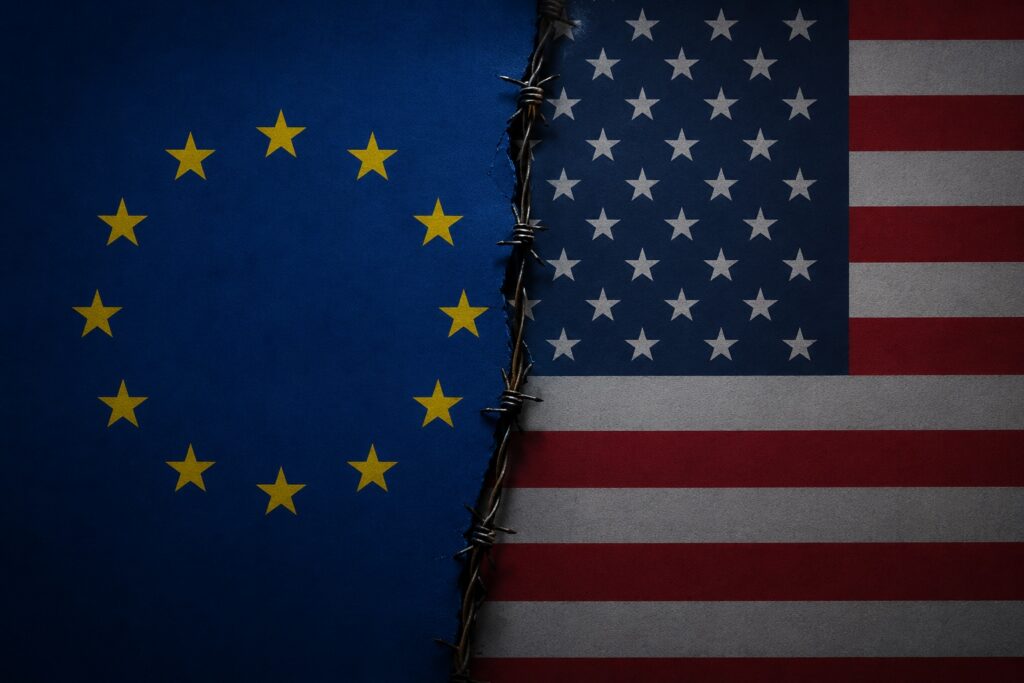
Europeans want to build their next tech champion. It’s a noble goal, and an important one. But rather than reforming the system to make it possible, why does the European Union spend most of its time and energy dismantling American ones?
On June 25, the European Commission took another step to ratchet up its regulatory oversight of American companies. It announced a preliminary position to pull Amazon Web Services and Microsoft Azure into the Digital Markets Act’s “gatekeeper” regime, even though neither cloud service meets the law’s usual quantitative thresholds.
The mantra: when the rules don’t catch the companies you want to punish, you stretch the regime until they do. Should the U.S. respond in kind to European companies?
The American Obsession
That is the whole gambit. The DMA was sold to Europeans as a legal tool to make digital markets fairer. In practice, it is a regulatory regime purpose-built to handicap American tech. Six of the seven companies designated as gatekeepers are U.S.-based or have U.S. parent companies.
They face fines reaching 10% of global revenue, mandates to share data with rivals, and endless oversight and fines from regulators who change the criteria when it suits them. Google is reportedly staring down a fine in the high-triple-digit-million-euro range. Apple already absorbed a €1.8 billion penalty that will inevitably be passed down to consumers.
While the European Commission argues these rules address genuine concerns about market power and contestability, even senior European figures — including former European Central Bank President Mario Draghi — have acknowledged that the current regulatory approach needs major reform if the continent wants to be competitive.
This is the same “regulate first, innovate later” mindset Brussels has championed for years, in hopes that talent and ideas will somehow spring from a stable, regulated environment. If that worked, Europe would have dozens of homegrown tech unicorns vying for global dominance. Instead, it has a thick rulebook and a sizable exodus of capital and talent.
What makes the DMA worse than misguided is that it is aimed principally against Uncle Sam. While Chinese platform TikTok has faced designation, many others (Temu, AliExpress, etc.) operate largely outside the DMA’s scrutiny. President Trump put it plainly last summer when he said Europe’s rules discriminate against U.S. firms while giving a pass to China. He was right.
Homegrown Heroes Play a Different Game
Then there are European companies that use Brussels’ rulebook to their advantage abroad while largely escaping similar scrutiny at home. Spotify is the clearest example. The Swedish streaming empire spearheaded a global lobbying campaign under the banner “Time to Play Fair,” filing the 2019 antitrust complaint that led to the €1.8 billion fine against Apple. The worst part? Spotify holds a commanding lead over Apple Music in the European streaming market.
Or look at Deutsche Telekom. The German company controls T-Mobile US, the second-largest mobile network in America. At the end of 2025, T-Mobile US had 142.4 million customers and generated €78.1 billion in revenue, well over half of Deutsche Telekom’s global total.
A European champion runs one of the largest companies in one of the most concentrated sectors of the American economy, under its own Magenta brand, and faces nothing like the scrutiny Brussels reserves for U.S. firms operating in Europe. The U.S. Trade Representative Jamieson Greer has already flagged that Europe’s digital rules impose burdens that disproportionately affect U.S. firms.
A Level Playing Field
Brussels has abandoned any pretense of a level playing field or a fair case for consumer choice. It wants market access without reciprocity: America’s market open to European companies, and Europe’s market stacked against ours.
The tools to respond already exist. Washington can make clear that one-way enforcement carries a price. If the EU continues applying these rules primarily to American firms, the United States has clear tools to respond in kind, including applying equivalent scrutiny to European companies operating in the U.S. market, from Spotify to Deutsche Telekom to Nokia and Ericsson.
Trump already warned that American technology companies are “neither the ‘piggy bank’ nor the ‘doormat’ of the world any longer.”
It’s time Brussels learned the door swings both ways.