


Italy is on the right path. Faced with high rents and too few homes on the market, Rome has chosen to treat the problem as what it is: a supply shortage. Instead of the caps and bans that have failed from Berlin to San Francisco, the government is using financial incentives to make renting to residents worthwhile again.
What Rome announced
On 28 October, Giorgia Meloni’s cabinet approved the draft 2027 budget law. Its housing package rewrites the cedolare secca, the optional flat tax that individual landlords can pay on rental income instead of ordinary income tax (La Legge per Tutti).
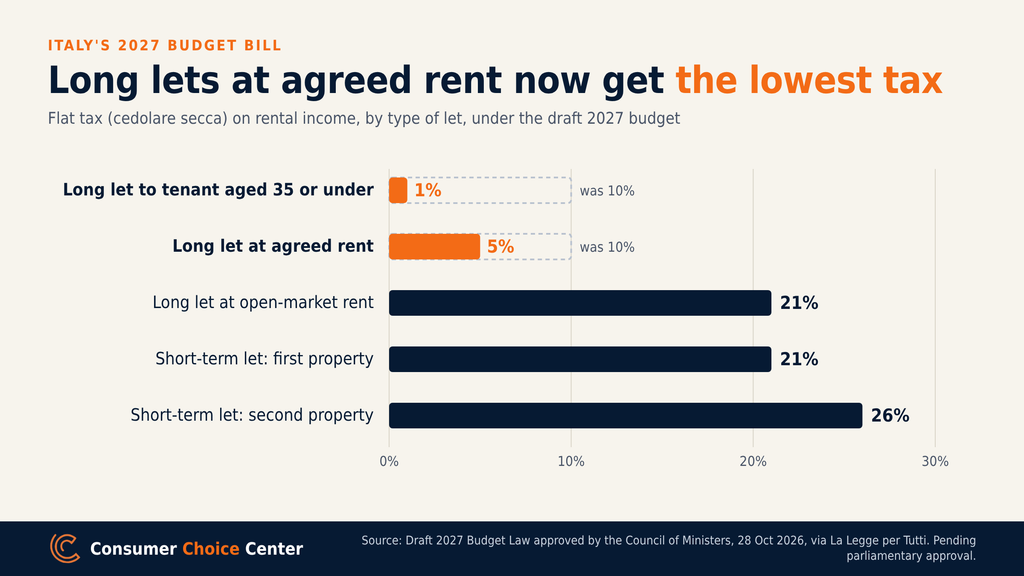
- Long-term “agreed-rent” contracts (canone concordato, such as the classic 3+2 lease): the flat tax drops from 10% to 5%.
- Tenants aged 35 or under on those contracts: the rate falls to just 1%.
- Small shops under 300 m²: a 21% flat tax returns for commercial lets, a measure last tried in 2019 (idealista).
The numbers are striking. A landlord letting a flat at €800 a month under an agreed-rent contract pays €960 a year in tax today. Under the new rules that falls to €480, and to €96 if the tenant is under 35. The measures still need Parliament’s approval, normally by 31 December, and would apply from 1 January 2027 (Leggo).
Rent control: a cure that shrinks the patient
Rent control promises cheaper homes but delivers fewer of them. The evidence is consistent across very different cities.
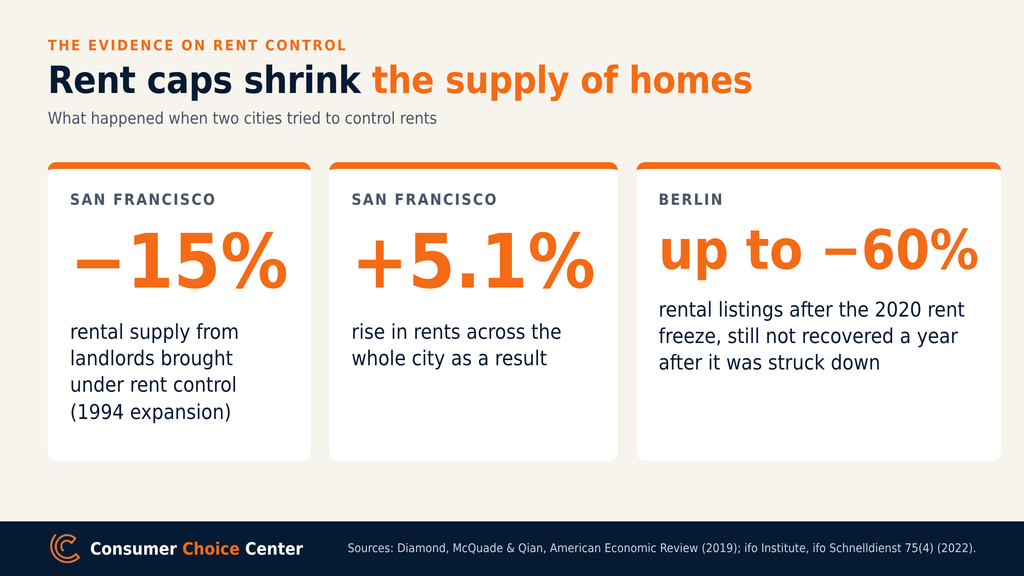
- San Francisco. Stanford economists studied a 1994 ballot measure that extended rent control to small apartment buildings. Affected landlords cut their rental supply by 15%, converting units to condos or selling to owner-occupiers. The result was a 5.1% rise in rents across the city (Diamond, McQuade & Qian, American Economic Review, 2019).
- Berlin. The 2020 Mietendeckel froze rents until Germany’s Constitutional Court struck it down a year later. The ifo Institute found the supply of rental listings in the city shrank by up to 60%, and had not recovered after the cap was lifted (ifo Institute). A separate DIW study found part of that stock appears permanently lost to renters (Management Science, 2024).
- Italy itself. Italians do not need foreign case studies. The 1978 equo canone law set rents by an administrative formula. Within two years, even the left-wing daily l’Unità was reporting that finding a flat to rent had become almost impossible (l’Unità, 1 May 1980). A black market in off-the-books rents grew up alongside it, and Parliament scrapped the system in 1998 (l’Unità, 6 December 1998).
The pattern is always the same. Those lucky enough to hold a controlled lease benefit. Everyone still looking, often the young, newcomers and families on the move, faces a smaller, pricier market.
Why cutting taxes works where caps fail
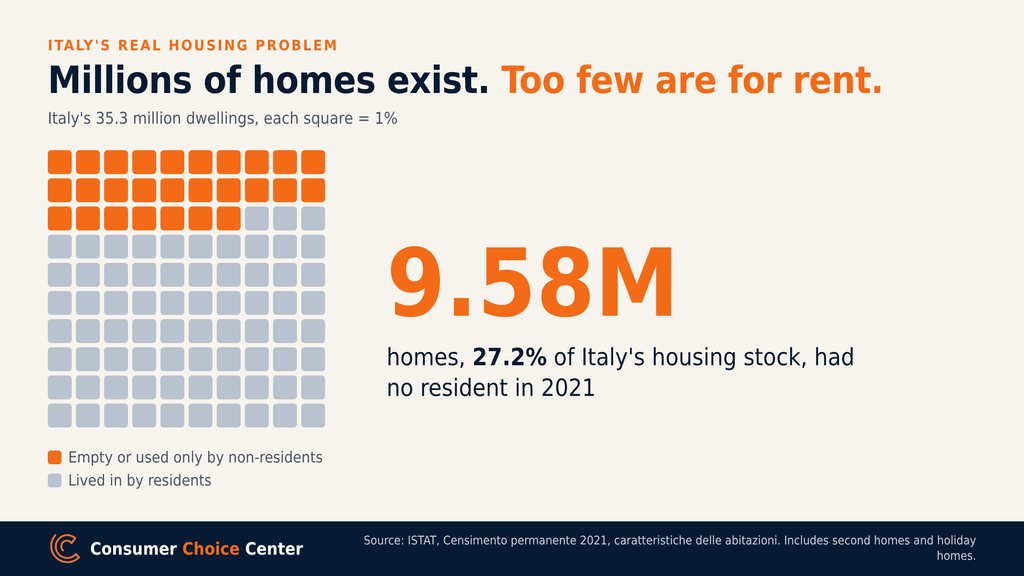
Italy’s problem is not a shortage of buildings. It is a shortage of homes on the rental market. ISTAT’s 2021 census counted 9.58 million dwellings that were empty or used only by non-residents, 27.2% of the national stock (ISTAT). Many are inherited flats or second homes that owners keep off the market because letting them is not worth the tax, the paperwork or the risk.
A cap makes that calculation worse; a tax cut makes it better. Rent control lowers what a landlord earns, so fewer owners rent. A lower tax raises what a landlord keeps, so more owners rent. Every flat that moves from empty, or from short-term tourist lets, into a long lease adds supply, and supply is what brings rents down for everyone.
The new rates also change the comparison with tourist lets, which pay 21% on a first property and 26% on a second. With the long-term rate at 5%, the gap widens to 16 and 21 points, and to 20 and 25 points for under-35 tenants (La Legge per Tutti). Rome is steering owners toward residents with a carrot, not a ban.
The under-35 rate is the cleverest piece. Young tenants often have short contracts and thin guarantees, which makes landlords wary. A near-zero tax turns them into the most attractive tenants on paper. Compare a flat let on the open market at €1,000 a month, taxed at 21%, with the same flat let to a 28-year-old at an agreed €800. The owner keeps €9,480 a year in the first case and €9,504 in the second, before the 25% property-tax (IMU) discount that agreed-rent contracts already receive.
Building on the right foundation
The approach is right; the next step is to widen it. Three changes would let incentives do even more as Parliament debates the bill.
- It only rewards one type of contract. The cut applies to agreed-rent leases, whose rents must fall within bands set by local agreements between landlord and tenant associations. Owners on standard four-plus-four market leases still pay 21%. Rome is still nudging rents toward a negotiated price, only voluntarily. Extending a lower rate to all long-term leases would bring far more homes back without any price-setting at all.
- The paperwork can eat the benefit. To claim the reduced rate, a landlord needs a certificate from a signatory association confirming the contract complies with the local agreement. Without it, the tax break can be clawed back (La Legge per Tutti). Every extra stamp is a reason for a hesitant owner to leave a flat empty.
- Tax is not the only barrier. Owners also weigh how long it takes to recover a property from a non-paying tenant. Faster, more predictable enforcement would complement the tax cut and cost the treasury nothing.
Some critics argue that a tax break for landlords is not a rent cut for tenants. That misreads how rents are set. Prices follow the balance between available homes and the people looking for them, and incentives that bring more homes onto the market tip that balance in tenants’ favour, without the shortages that caps create.
A lesson for Europe
From Barcelona to Berlin, politicians facing angry renters keep reaching for caps and bans. Italy lived with price controls for twenty years under the equo canone and walked away. Its new budget shows the lesson has been learned: high rents are a supply problem, and supply responds to incentives, not decrees.
Consumers win when there are more homes to choose from, not when the state rations the few that exist. Italy is on the right path. Parliament should pass these cuts, then extend them to every long-term lease.
Sources
- Affitti, cedolare all’1% per gli under 35 e al 5% sul concordato, La Legge per Tutti, 29 October 2026
- Cedolare secca, dal 10% al 5% sul canone concordato e 1% per gli under 35, Leggo, 29 October 2026
- Cedolare secca immobili commerciali 2027, idealista, 30 October 2026
- The Effects of Rent Control Expansion on Tenants, Landlords, and Inequality, Diamond, McQuade & Qian, American Economic Review, 2019
- Rent cap shrank supply, ifo Institute, 2022
- Forward to the Past: Short-Term Effects of the Rent Freeze in Berlin, Hahn et al., Management Science, 2024
- Censimento permanente 2021: caratteristiche delle abitazioni, ISTAT
- l’Unità archive, 1 May 1980 and 6 December 1998