
Off the Rail or on the Books:

Problem Gambling and Smart Regulation

KEY TAKEAWAYS

Bans and steep taxes drive bettors offshore to unregulated sites with no age verification, no deposit caps, and no self-exclusion.

Problem gambling rates are flat, returning to 2018 baselines despite a 3,000%+ rise in legal betting volume since the Supreme Court’s 2018 Murphy v. NCAA ruling.

Competitive, moderate-tax markets work. Connecticut’s regulated market (including iGaming) has a lower problem-gambling rate today than it did in the 1990s — before mobile sportsbooks existed. Indiana maintains moderate taxes, clear rules, and has similarly low problem-gaming numbers.

Smart policy: debit only transactions, age verification, self-exclusion tools, and rejection of punitive tax proposals in North Carolina, Virginia, Illinois, and elsewhere.

The Numbers Don’t Match the Headlines

The dominant media narrative, that legalized sports betting has triggered a crisis of addiction among young men, is not supported by national data. It is more nuanced and reassuring than the headlines suggest.
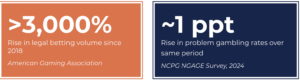
The National Council on Problem Gambling’s 2024 NGAGE Survey — the most comprehensive national tracking study available — found that risky gambling behaviors fell roughly 27% from their 2021 pandemic peak, returning to 2018 baseline levels. About 7–8% of Americans reported at least one warning sign of problematic gambling in 2024. Participation in sports betting also declined from 26% in 2021 to 23% in 2024.

The 2021 spike is the key context critics usually omit. Mass lockdowns, pandemic stimulus payments, and the Wall Street Bets phenomenon all drove a broad surge in risky financial behavior — not just gambling. The spike reflected the COVID outlier moment, not a structural shift driven by the legalization of betting.

Even among the highest-risk demographic, young men, the overwhelming majority do not develop a problem. The policy question isn’t whether we can erase this risky behavior (you can’t, in a country of smartphones and convenience stores). The question is whether it happens in a market with guardrails or one without.

Who actually bets — and who has a problem

  1. Of the 57% of Americans who gamble in some form, 43% buy lottery tickets and 36% buy scratch-offs via government-run games [Fairleigh Dickinson University Poll, 2024]
  2. Only 10% have placed a sports wager.  [FDU Poll, 2024]
  3. 10% of Americans aged 18–30 show “some characteristics” of problem gambling — mostly men, across all gambling categories. 
  4. The most popular forms of gambling are government-run. The most politically acceptable forms carry the same risks as big-name private firms.

Two Models: Good Outcomes Come First

GOOD POLICY

  • Competitive licensed market, moderate tax rate (Indiana, 9.5%, Connecticut, 13.75%)
  • Debit-only deposits, age verification, self-exclusion
  • Dedicated problem-gambling funding from legal revenue
  • Result: illegal market shrinks, prevalence falls, state collects revenue

BAD POLICY

  • State monopoly or near-total ban (Montana)
  • Punitive stacked taxes (Illinois, New York)
  • Copycat proposals: North Carolina, Virginia, Indiana, Massachusetts
  • Result: consumers migrate offshore, tax revenue lost, no consumer protections

❌ Montana: What a State Monopoly Looks Like

Montana’s legal sports betting volume was just $66 million in 2024, akin to a rounding error nationally.  [Montana DOJ Annual Performance Report, FY2024]

The state’s own Department of Justice identifies illegal online betting as the “greatest threat” to its regulated market — meaning offshore bookmakers with no ID verification, no deposit caps, and a litany of cybersecurity risks — are growing market share.  [Montana DOJ, FY2024]

When a state tries to control a consumer activity by monopolizing it, the activity doesn’t stop. It just leaves the building far from the eyes or control of any regulator or law-abiding platform.

Illinois: Stacked Taxes, Migrating Bets

  • 2024: flat 15% sports betting tax replaced by graduated rate of 20-40%.
  • 2025: per-wager fee added (25¢ per bet for first 20M bets; 50¢ thereafter).
  • 2025 (Chicago): additional 10.25% local sports betting tax.

Result: Illinois recorded a 15.4% decrease in sports bets placed in November 2025, 6.1 million fewer bets than in November 2024.  [Illinois Gaming Board, November 2025 Sports Wagering Report]

Those bets didn’t disappear. They migrated to jurisdictions where those taxes don’t apply.

Connecticut: The Model That Works

Connecticut legalized online sports betting in 2021, with a competitive market structure and a 13.75% tax on online sports betting. Three years in:
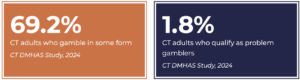
For comparison: Connecticut’s own historical surveys put problem-gambling prevalence at 3.2% in 1991 and 2.9% in 1996 — long before mobile sportsbooks existed.  [CT DMHAS, 2024]

Connecticut paired legalization with debit-only deposits, statewide self-exclusion, and funding for a helpline. The legal market crowded out the illegal ones. When critics insist that legal sports betting worsens addiction, Connecticut is the clear rebuttal. The state of Indiana, with similar rules and a tax framework, follows this track, with just 2.6% of surveyed adults who found they “considered” being dependent on gambling. [IU Survey, 2024]

The Offshore Reality

The illegal and unregulated gambling market is not a minor side-effect of bad policy. It is the direct and predictable product of it.
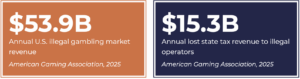
One in ten sports bettors in the U.S. still wagers exclusively through illegal channels.  [AGA, 2025] Since legalization expanded, illegal sportsbooks’ market share has dropped from 36% to 24%, progress that higher taxes and restrictions would reverse.

The UK offers a preview of where over-restriction leads. As British regulators tightened restrictions and raised taxes, illegal operators grew to roughly 9% of the market. More than one in five 18-24-year-olds who bet in the UK now use unsafe, unregulated sites — precisely the young men regulators claimed to protect.

Offshore sites accept credit cards, have no age verification to speak of, no deposit limits, do not honor self-exclusion, and are often linked to organized crime that commits extortion and hacks against consumers in the United States. [FBI, 2025]  Legal U.S. sportsbooks are required by state regulators to have all of these. The consumer protection critics say they want already exist on the legal market, and these critics want to price out the appeal of legal gaming.


What Smart Regulation Looks Like

Policy Recommendations
1. Replicate Indiana and Connecticut’s frameworks: competitive licensed market, moderate tax rate, built-in consumer protections. Reject state-monopoly models (Montana) and punitive, stacked taxes (Illinois).
2. Mandate debit-only transactions, age verification, and practical self-exclusion as conditions of licensing — not add-ons.
3. Direct a dedicated share of legal sports betting revenue to problem-gambling treatment and prevention — funded by the legal market that benefits from a healthy regulatory environment.
4. Pursue offshore enforcement. A coalition of 50 state attorneys general petitioned the DOJ in 2025 to crack down on illegal offshore operators. That effort deserves legislative support — it is the intervention most directly protective of vulnerable gamblers.

The Bottom Line

Young men will disproportionately engage in betting, whether it’s legal or not, just as they build crypto portfolios, engage in prediction markets, and take more physical risks than other demographics. Regulations alone cannot erase these tendencies. However, policy can help determine whether a young man’s worst night happens on a regulated app with a deposit cap and a self-exclusion option — or on an offshore site with no limits, no ID check, and no recourse. That’s the real choice before lawmakers in Virginia, Indiana, and every state considering higher taxes or tighter restrictions on the legal market. Consumer choice is the foundation of the American economy and a free society. The best consumer protections are transparent guardrails — not policies that sweep risky behavior under the rug while deferring accountability.

Read the Full Report

Authors

Picture of Emil Panzaru

Emil Panzaru

Research Director

Picture of Yael Ossowski

Yael Ossowski

Deputy Director

You might also be interested in