
If We Allow It
The promise of autonomous vehicles is too significant to leave stranded by regulatory uncertainty.
Autonomous Vehicles (AVs) represent the next great chapter in America’s transportation story. While AVs continue to improve thanks to pilot tests and full commercial deployment in numerous cities, the technology faces an increasingly hostile and complex regulatory environment.
This primer will review the current state of AV technology and its benefits to U.S. consumers, and make policy recommendations that lawmakers can consider as they examine this emerging policy area. Also, you will find a number of policy proposals that federal and state lawmakers can consider to advance the development and deployment of AV technology to ensure that American consumers have access to and benefit from the next generation of transportation technologies.
THE STATE OF AUTONOMOUS VEHICLES
Although autonomous vehicles are often portrayed as a distant prospect, they are already operating commercially across the United States. Waymo, Zoox, and Tesla provide autonomous ride-hailing services in cities including San Francisco, Phoenix, Los Angeles, Austin, Miami, Las Vegas, Atlanta, and Charlotte. Autonomous trucks and delivery robots are also moving freight and completing last-mile deliveries.
Many of these services use Level 4 automation, meaning the vehicle performs the entire driving task within a defined operating environment without requiring a human to take control. In active service areas, autonomous vehicles routinely navigate construction zones, respond to pedestrians, and yield to emergency vehicles.
Autonomous transportation is no longer a theoretical possibility. Its commercial deployment is expanding, and the policy decisions made today will determine how broadly consumers can access its benefits.
autonomous miles logged by Waymo
autonomous deliveries by Starship
driverless freight miles logged by Aurora
Consumer impact
Around 40,000 people die on American roads each year, with human error responsible for the overwhelming majority of crashes. Autonomous vehicles do not drive drunk or become distracted, and their sensors provide 360-degree awareness during the day and at night. Across millions of autonomous miles, Waymo reports 94% fewer serious-injury-or-worse crashes, 82% fewer injury-causing crashes, 93% fewer pedestrian crashes with injuries, and 84% fewer injury-causing crashes involving cyclists and motorcyclists. Good policy should neither require every vehicle to be driverless nor prevent consumers from choosing a demonstrably safer option.
Roughly 20 million Americans have a disability that limits their ability to travel. As Baby Boomers age, millions more will face increasing difficulty driving. These mobility limitations can lead to social isolation and reduce opportunities to work, access healthcare, visit family, and participate in community life. Reliable autonomous transportation could help people with disabilities and older adults reclaim personal agency, remain connected to their communities, and continue living independently.
Car ownership places a significant financial burden on households through financing, depreciation, insurance, fuel, and maintenance. Even a used car can cost a family between $6,000 and $8,000 annually. Shared autonomous vehicles could reduce the need for households to own multiple cars, while fewer crashes could lower insurance costs. AVs could also help older adults remain in their homes rather than enter assisted-living facilities that average more than $5,000 a month. In freight, autonomous trucks could reduce shipping times by as much as 40%, generating billions of dollars in consumer savings.
Autonomous ride-hailing could provide a safer alternative for women traveling alone or at night by removing the risk of harassment or assault by a driver. It could also reduce racial discrimination in transportation. Research has found that African American passengers can experience longer waits and more frequent cancellations on rideshare platforms. Autonomous vehicles have no preference about a passenger’s name, identity, or destination. They do not refuse an inconvenient airport trip or cancel because the return journey may be unprofitable. Once a ride is accepted and paid for, the vehicle simply completes it.
The policy challenge
Despite evidence demonstrating the safety and consumer benefits of autonomous vehicles, deployment faces growing resistance from outdated regulations and established interests threatened by new competition.
Federal rules still assume a human driver. Standards require steering wheels, pedals, and other components that purpose-built AVs may not need, while the 2,500-vehicle exemption cap keeps production at prototype scale.
Special requirements make safer transportation more expensive. Insurance mandates of between $5 million and $10 million, human-operator requirements, and quotas for human-driven rides raise barriers and pass additional costs to consumers.
State and local rules create hard borders. Permits, fleet caps, fees, and separate approval processes can make an AV legal in one jurisdiction but prohibited in the next.
Consumers should choose how they get where they are going—not be locked into one transportation model simply because it arrived first.
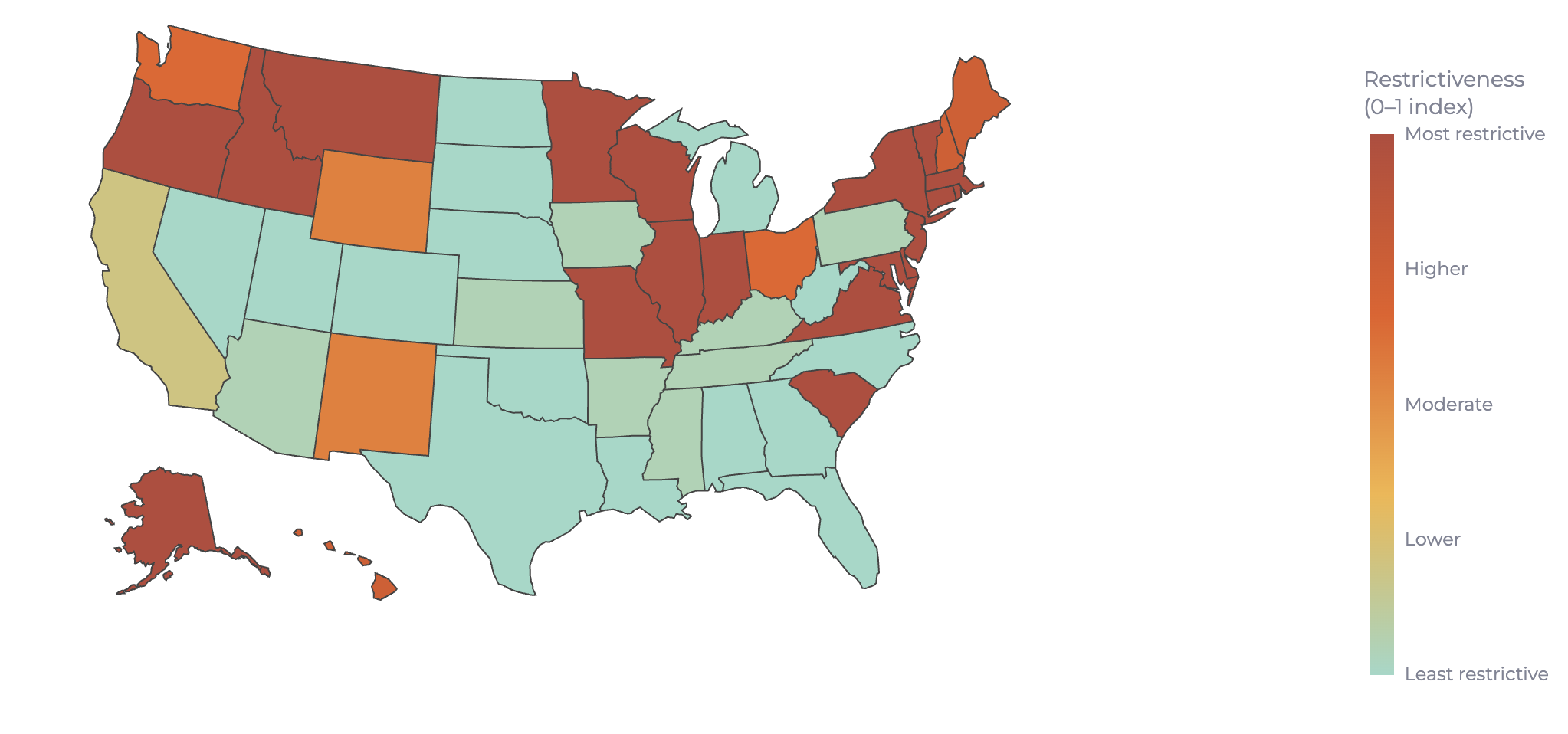
AVAT is a source-linked dashboard comparing legally binding restrictions affecting access to Level 4 commercial driverless passenger services across all 50 states and the District of Columbia.
It supports comparison of market-entry conditions, monitoring of state-level reform, and examination of the primary sources behind every classification and score.
The index measures four categories:
Scores run from 0 to 1, with higher values indicating a more restrictive framework. Missing evidence is marked Unclassified—never treated as zero. Proposed bills, voluntary guidance, market availability, and safety outcomes do not determine the index result.
policy
roadmap
To prevent further regulatory fragmentation, federal and state lawmakers should establish clear rules that protect consumers while allowing autonomous vehicle technology to develop and reach meaningful commercial scale.
NHTSA should update standards written for vehicles with human drivers. Congress should eliminate the 2,500-vehicle exemption cap—or raise it to at least 75,000—so AV production can move beyond prototypes and lower costs through mass-production economics.
States should establish consistent operating frameworks instead of leaving AV policy to a patchwork of local ordinances. Municipalities can enforce ordinary traffic laws, but should not add special permits, fleet caps, or operating fees.
Controlled deployment allows consumers, businesses, and regulators to collect real-world evidence and build rules around actual risks. Sandboxes can also test insurance approaches that compensate victims quickly without lengthy litigation.
AV operators should carry appropriate insurance and remain accountable when harm occurs, but comparable transportation services should face comparable obligations—without technology-specific liability rules, taxes, or fees.

Head of Emerging Technology Policy

Policy Intern