

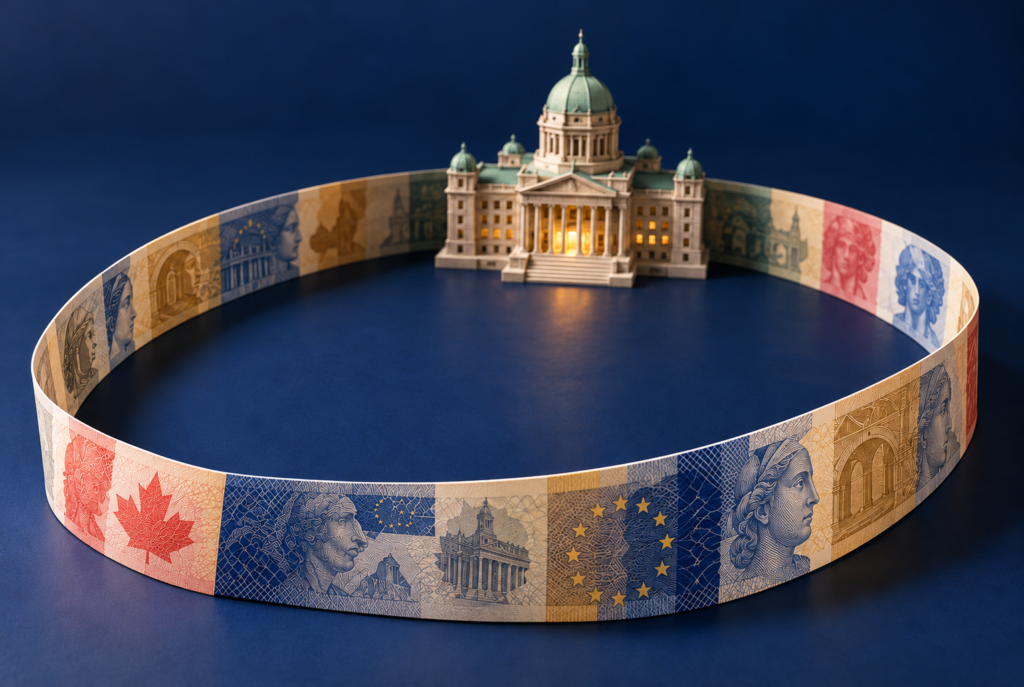
Back in April 2026, my colleague David Clement and I released a report on the practice of circular lobbying in Canada, or the practice of the government paying to lobby itself. Circular lobbying is an undemocratic practice where the government gives money to a supposedly “non-governmental” organization which then uses it to lobby the same government using taxpayer money. I knew this was not just a Canadian problem and that it was happening around the world, but I didn’t realise how widespread it was in Europe until I recently read a new report by the Hungarian think tank the Free Market Foundation that shows how bad it is in their neck of the woods.
As a policy expert and seasoned researcher, as well as someone who is very interested in the practice of circular lobbying and how it harms democracy and civil society, I am most interested in those aspects of the Hungarian report. There was so much to consider that I felt compelled to write about the hypocrisy, cynicism, and irresponsibility of the European Commission, the member states, and the NGOs involved, leading to a level of incompetence that seems unprecedented. I can only imagine how an everyday European would feel about trying to get any information about how European NGOs use public funding.
Canada and the European Union obviously exist in very different contexts. Canadian circular lobbying happens within one country of almost 42 million people, while the European Union is allowing this practice to take place amongst a population of 452 million people split up into member states. This much larger context allows the practice to be more widespread, harm far more people, and in some ways, allows it to be quite invisible amidst the many other issues happening across the European Commission and all of its member states. One might also expect that a much larger population with a much bigger bureaucracy would allow for more avenues of transparency on who is giving NGOs money and how that money is spent, but unsurprisingly, that assumption would be incorrect.
As researchers in Canada, it was quite easy getting the data we needed for our report, although the data was often still flawed. There are two very clear sources of transparency in terms of government funding in Canada. To determine how much federal, provincial, municipal money each charity receives, we looked at the Government of Canada’s Canada Revenue Agency’s charity search. We were also able to determine whether a charity employed public relations professionals by reviewing the publicly available lobbying register. This register exists because the Government of Canada requires every entity that lobbies the government to maintain a record of that interaction, accessible to the public through this website.
As I read the Hungarian paper, I was struck by the fact that in a system that boasts about its extensive bureaucracy, the same tools do not seem to exist. One would think that European bureaucrats would be chomping at the bit to require more of NGOs so that they have even more data and more websites that they can build and manage. However, it seems the researchers of the Hungarian paper had a very hard time getting all of this information. They state:
“the Transparency Register does not include all the information needed for a thorough
analysis of the circular lobbying practices in the European Union. For one, NGOs are only
required to submit operating budgets as well as contributions received that are more than
€10,000 and that exceed 10% of their total budget. This does not give citizens and
researchers a full financial picture to scrutinise the organisation”,
and,
“It should not take EU citizens an exorbitant amount of time and resources to deduce how much money an organisation receives from the European Commission or member states by having to review both the Transparency Register and Annual Reports”
It is disconcerting that anyone has to do that much digging just for basic transparency, and that the European Commission puts so little effort and so little pressure on obtaining and maintaining these records. The only conclusion I can come to as a researcher is that, first, these bad practices are so entrenched into the mechanism of government in Europe that they are secondary and merely a formality (when they are actually implemented), and second, that everyone is just a bit too familiar, what with 110 individuals for just those nine organizations mentioned in the report with accredited access to European Parliament premises.
We are not immune in Canada. The money flowing in from the government to “non governmental” organizations is also stunning, and the amount of NGOs that employ public relations firms to continue their lobbying efforts (often lobbying the government for even more taxpayer money) is disheartening for those interested in strengthening democracy and civil society. Canada is looking to Europe when it comes to trade these days, we are becoming closer friends and allies in an increasingly unstable world. This is great news for trade, but Canada would do well to try and avoid falling even further into the traps of complacency and collaboration when it comes to bad practices in civil society.
The recommendations put forth by the Free Market Institute should seem basic, and yet the complete failure in maintaining transparency has forced them to recommend things that should be obvious, like forcing NGOs to disclose all of their expenses, and asking for more accessible platforms where Europeans can access that information. There is a serious problem in Europe if these basic requests are ignored, and Europeans should hold their governments accountable for not maintaining this level of transparency. Both Canada and the European Union still have a long way to go to curb this undemocratic practice, and think tanks holding a mirror up to these organizations is a good first step to making that happen.