


More than half of America’s mapped data centers sit in five states. California is the only one where households pay far above the national average, and data centers don’t explain why.
WASHINGTON, D.C. — More than half of the 1,715 U.S. data centers in a new Consumer Choice Center map sit in just five states, and three of those five pay less than the national average for home electricity. Households in Virginia, Texas and Oregon paid between 15.4 and 16.8 cents per kilowatt-hour through July 2026, against a U.S. average of 18.2 cents, according to U.S. Energy Information Administration (EIA) data.
The map puts numbers on a debate that has mostly run on assumptions and vibes.
“Data centers have become an easy villain at every town hall about power bills, but the numbers don’t back it up. If they were the cause, Virginia would have the highest rates in America and it doesn’t. Four of the five biggest data center states pay below or close to the national average for home electricity. Household bills are driven by many factors, such as transmission lines, pipelines, energy sources and policy costs baked into rates. There’s no single culprit, and the data doesn’t point to data centers.” — Fabio Fernandes, Director of Marketing and Communications, Consumer Choice Center
Virginia leads the country with 389 mapped sites, followed by Texas (197), Oregon (128), California (111) and Ohio (92). Ohio households pay 18.7 cents, roughly in line with the national average. The U.S. Department of Energy estimates data centers used 4.4% of U.S. electricity in 2023, a share projected to reach 6.7% to 12% by 2028, which is why the question of who pays for new power lines and plants matters. Several states and utilities already require the largest customers to cover those costs themselves.
“California proves the point from the other direction. Its households pay 33 cents per kilowatt-hour, more than 80% above the national average, and the drivers are well documented: the cost of delivering power, wildfire prevention and state policies built into rates. Questions about location, noise and energy availability are real, and local councils are the right place to settle them. But blaming the data centers that power our streaming, banking and shopping won’t lower anyone’s bill. Making the biggest users pay for the grid they need will.” — Fabio Fernandes, Director of Marketing and Communications, Consumer Choice Center
The Consumer Choice Center supports sensible legislation that fosters consumer abundance, and urges state lawmakers and utility regulators to weigh all of these variables when regulating data centers rather than pass moratoriums that block investment and add to the cost of living.
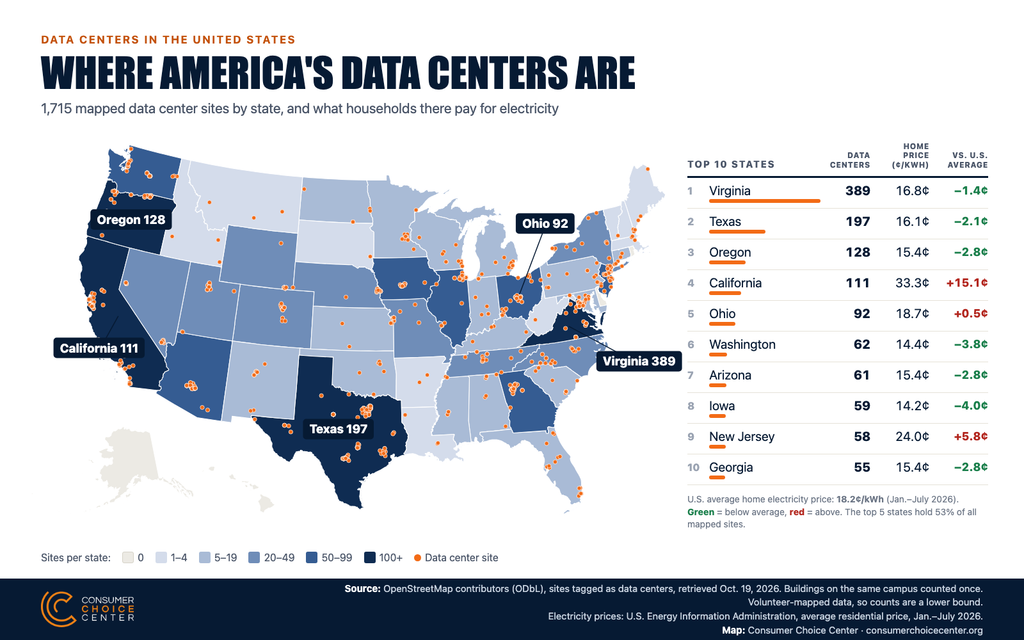
Methodology: Site counts come from OpenStreetMap and are a lower bound. Electricity prices are EIA average residential rates, year-to-date through July 2026.
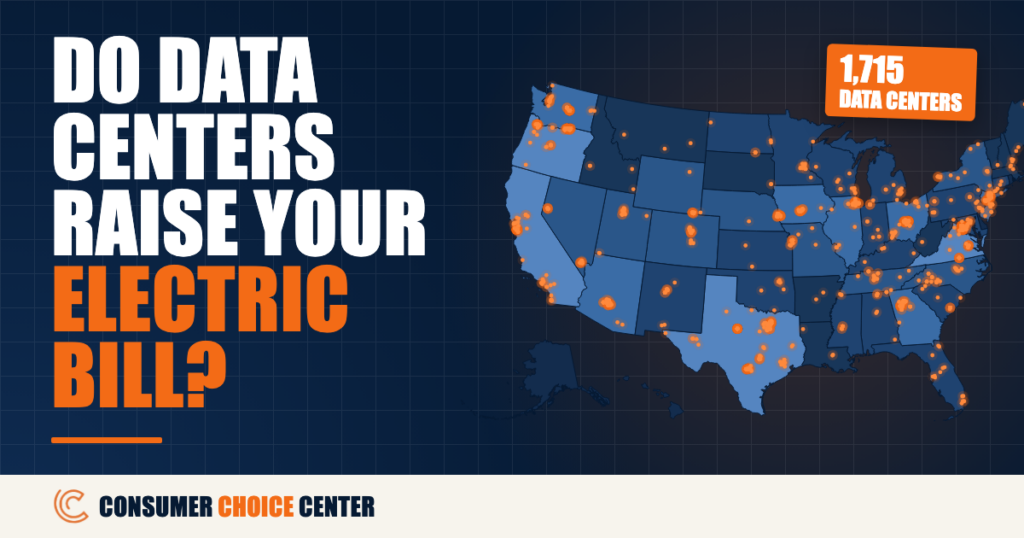
Mapping America’s Data Centers For Consumers
Are data centers driving up electricity prices? Every stream, video call, bank transfer, and AI prompt runs through a data center somewhere. This interactive map shows how many data centers each state has, what households there pay for electricity, and what consumers get in return.