On rumors of an FTC investigation into sports books
Investigations into market practices are part of a well-regulated market, and do not point toward a case for prohibition.
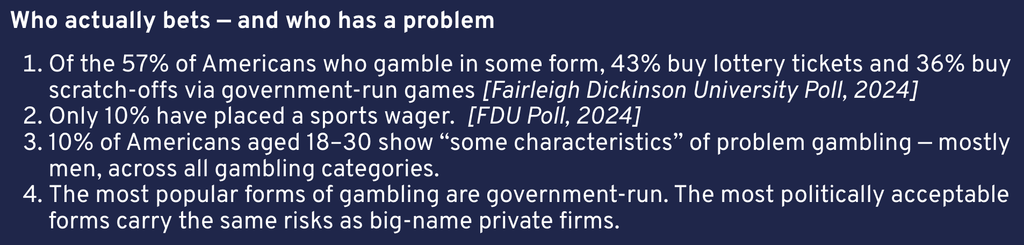
The vast majority of Americans do not place wagers of any kind, and of those that do, only a fraction exhibit signs of problem betting.
Remember: The most widespread forms of gambling are still government-run lotteries, with advertisements targeting lower-income communities.
WASHINGTON, DC —OCT 13, 2026— Following a Washington Sun report suggesting the Federal Trade Commission (FTC) is examining the sports betting industry, the Consumer Choice Center (CCC) urges caution about treating preliminary agency discussions as a formal investigation. The report cites anonymous sources describing an early-stage review, but no formal investigation has been publicly confirmed. DraftKings says it has received no Civil Investigative Demand from the agency, nor any other sportsbook.
DAVID CLEMENT, Director of Policy at the Consumer Choice Center,responded:
“It’s not clear that an FTC investigation into online sportsbooks actually exists. The Sun bears the hallmarks of a wish-casting PR strategy to encourage an investigation that is not currently underway. That said, deceptive advertising and predatory marketing practices deserve serious scrutiny in any regulated industry. That’s one of the benefits of bringing sports betting into the legal marketplace, where the public can have a say in regulation through their elected representatives, and agencies can examine behavior one a case-by-case basis. Lawmakers are empowered to establish clear consumer protections, and companies should always be held accountable when they break the rules. None of that requires treating adults who enjoy sports betting as incapable of making their own decisions—the vast majority of players to not exhibit signs of problem gambling.”
Consider the findings of our recent report on problem betting
CCC maintains that the legalization of sports betting provides an opportunity to improve transparency, establish enforceable marketing standards, and give consumers legal recourse when companies engage in deceptive practices.
The answer to bad conduct in a legal marketplace is better enforcement of clear rules, not a retreat from legalization. Driving sports betting back toward unregulated offshore markets would leave bettors with fewer protections and less accountability from sportsbooks.
Our report on problem betting identified the following key takeaways for lawmakers and regulators regarding effective consumer protections:
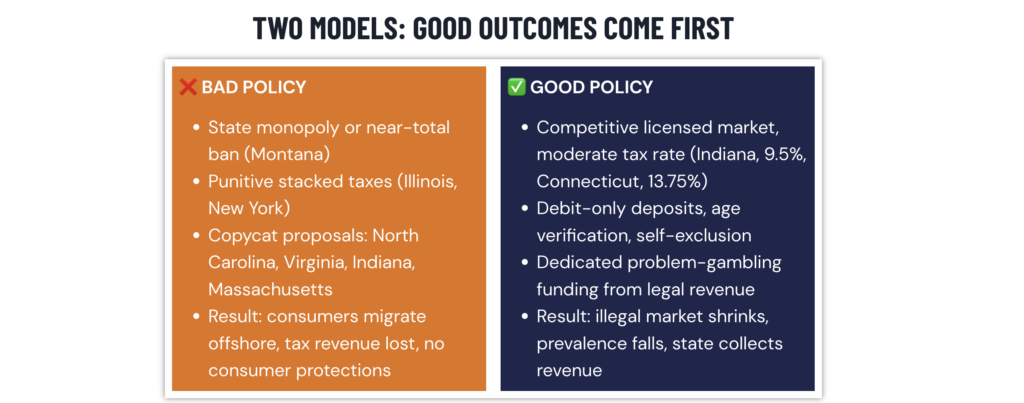
Bans and steep taxes drive bettors offshore to unregulated sites with no age verification, no deposit caps, and no self-exclusion.
Problem gambling rates are flat, returning to 2018 baselines despite a 3,000%+ rise in legal betting volume since the Supreme Court’s 2018 Murphy v. NCAA ruling.
Competitive, moderate-tax markets work. Connecticut’s regulated market (including iGaming) has a lower problem-gambling rate today than it did in the 1990s — before mobile sportsbooks existed. Indiana maintains moderate taxes, clear rules, and has similarly low problem-gaming numbers.
Smart policy: debit only transactions, age verification, self-exclusion tools, and rejection of punitive tax proposals in North Carolina, Virginia, Illinois, and elsewhere.