

Consumers aren’t feeling good about the economy
As American consumers head into the midterm elections, consumers are feeling the brunt of higher costs at the grocery store, more expensive gas at the pump, and rising prices on staples they need to live.
In the University of Michigan’s Surveys of Consumers released September 11, 2026, the index of consumer sentiment has dropped to 47.8, down from 55.1 exactly a year ago. Consumers are feeling the pressure on their monthly budgets, and not feeling optimistic about their own financial situations.
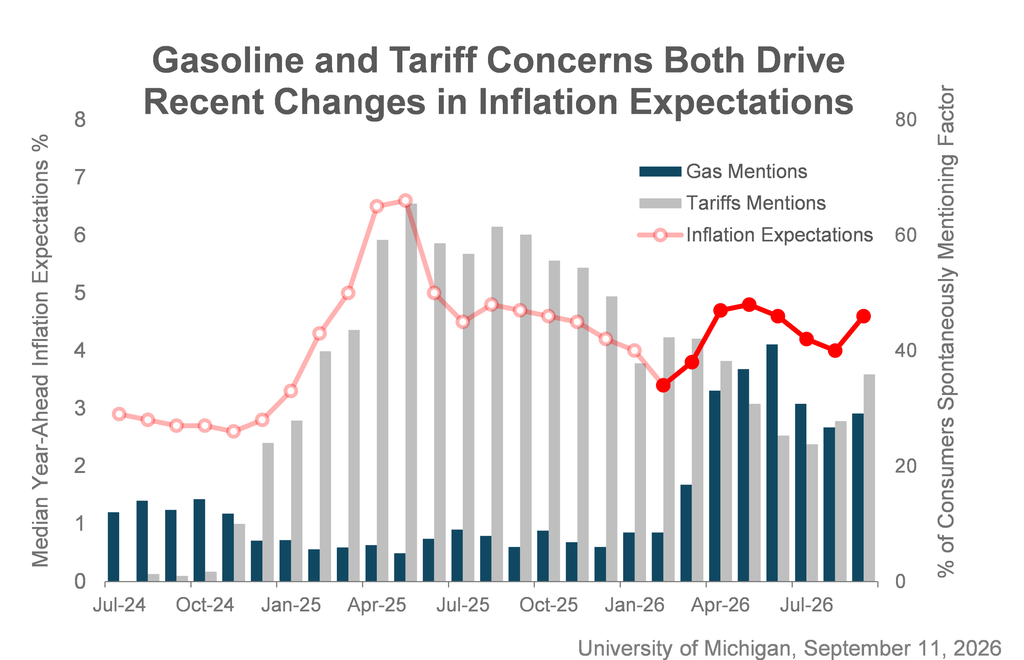
This is driven mainly by concerns about inflation, according to the survey data, as well as the impact of tariffs on everyday goods as the below chart reveals:
While technological progress is rapidly expanding in the AI sector, leading to the construction of more server farms, data centers, and industrial centers, other parts of the economy are stifled.
That’s especially true in transportation.
The Union Impact on Transportation Costs
Though autonomous cars like Waymo, Tesla Cybercabs, and Zoox are starting to hit American streets and give Americans more mobility options, they’ve been subjected to significant slowdowns driven by state and local red-tape.
This has been driven by active blocking by both union groups and trial attorneys in cities like Washington, D.C. and San Diego, seeing autonomous cars as threats to their business models. Some states are faring better than others, as the Consumer Choice Center’s Autonomous Vehicle Access Tracker demonstrates.
The same can be seen with autonomous trucking. During the markup of the BUILD America Act in May, the Teamsters union excoriated the $580 billion Surface Transportation budget for having provisions that would ease the rules around autonomous trucks on American highways. Other unions have joined up to oppose autonomous trucks, despite the real gains for safety.
By lowering labor costs for both mobility and trucking, while upholding safety, consumers would benefit from the millions in savings passed on to them. That’s a key win for affordability.
The Railway Safety Charade
Back in May, we called out the amendments to the BUILD America Act that ended up adding the Railway Safety Act into the bill as an amendment. Framed as a safety reform, the RSA aims to impose prescriptive operational mandates: two-person crew requirements, congressionally-specified defect-detector standards, and inspection protocols. These are clear union demands.
But these operational mandates would raise costs without measurably improving safety, what the amendment is supposed to address. By locking in early-2000s practices via federal statute, it prevents adoption of cost-saving technology that many private rail firms are implementing now to be more efficient, including precision control systems, and automated wayside detection. Those are clear practices that improve safety outcomes faster than crew-size rules.
In a House Subcommittee meeting today, Congressional members are hearing about the impact of union politics on affordability politics in Washington.
With that in mind, they should also pay heed to how union demands are directly shaping how consumers are getting products delivered to their store shelves and doorstops. And specifically, how those demands will lead to higher costs for companies that consumers rely on.
Baking in crew mandates and union promises to a transportation funding bill is the wrong vehicle for delivering more affordable goods and services for consumers. Food, energy, and finished goods almost all travel by rail at some point between port, factory, and warehouse. Cost increases pass directly to the prices working families pay. These types of mandates slow down innovation and make it more expensive to ship goods to the people who need them.
CCC’s policy primer The Consumer Case for Reimagining and Innovating Railroad Policy documents how central-planning approaches to rail regulation historically raise shipping prices and reduce competition.
We believe in the future
For other technologies and services, especially autonomous vehicles that provide ride-hailing and trucks that can ship goods, Congress must lean into the future rather than clinging to the past.
Unions have a place in protecting their members and influencing the debate, but that shouldn’t come at the cost of consumers’ own pocketbooks.